Guides / What Muscles Does Each Exercise Work? (With Percentages)
What muscles does each exercise work, in numbers
Search any movement and you get a list: the barbell row works the lats, rhomboids, traps, rear delts and biceps. True, and almost useless - because it does not say whether the row finishes your lats or barely touches them, and those are completely different pieces of advice. Here is the same question answered with magnitudes.
By Mike Zino, founder · Updated 2026-09-08
What a percentage here means
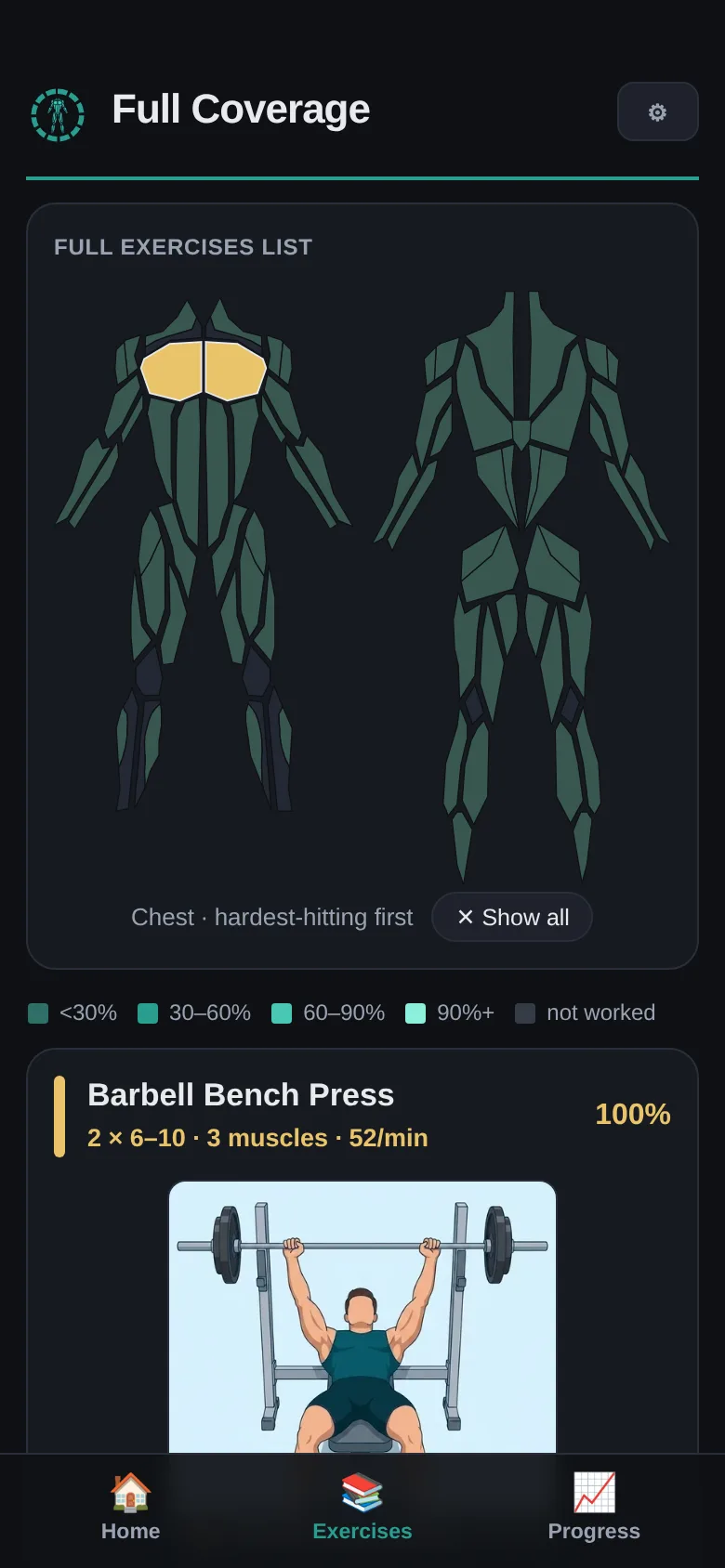
A percentage is the share of one session’s target for that muscle which a single movement delivers, performed at its prescribed sets and reps. So:
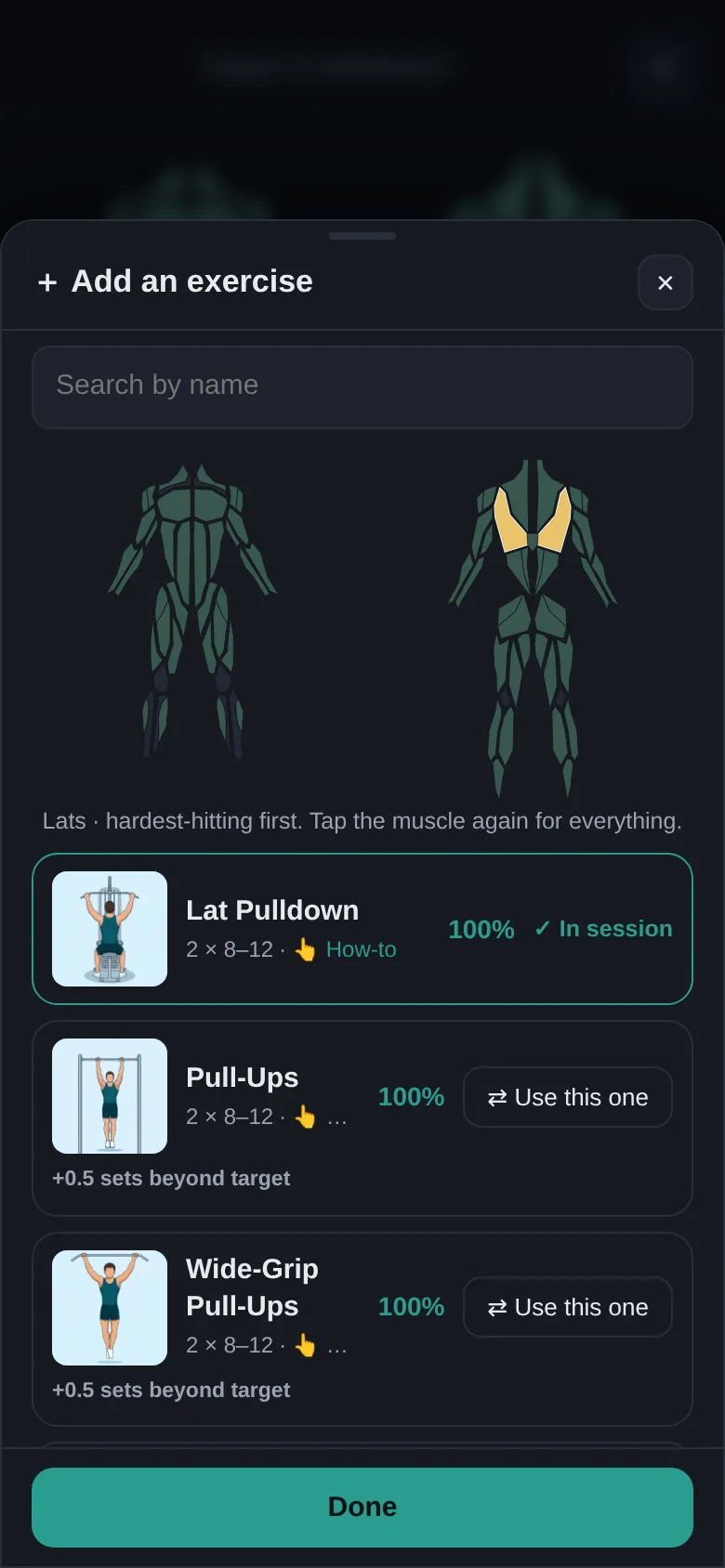
100% means one exercise finishes that muscle for the session on its own. Do a set of lat pulldowns as prescribed and your lats are done.
45% means the movement does close to half the job for that muscle while it is really training something else. The barbell squat gives the glutes 50% - a real contribution, and not a glute exercise.
10% is a rounding error you should not count on. It is listed because it is true, not because it is useful.
Volume is counted in sets per muscle, with an assisting muscle counted as a fraction of a set - the quantification method with the best evidence behind it Pelland 2025. The figures are hand-calibrated per movement against the rules in our own audit, not lifted from EMG amplitude, which does not predict growth well enough to prescribe from Vigotsky 2022.
Why the list-without-numbers version misleads
Two habits follow from reading exercise descriptions that name muscles without weighting them.
You count an assist as coverage. “Rows work the biceps” is true, and if you then skip curls on that basis your biceps get about half of what they need. The row is a back exercise that involves the biceps, which is a different claim from a biceps exercise.
You count a compound twice. Bench press, incline press and dips all name “chest, front delts, triceps”. Doing all three does not cover three things; it covers one thing three times, and the front delts end up at triple their target while the side delts - which no pressing movement trains meaningfully - stay at zero. That is the single most common gap we measure, and it is invisible if all you have is a list of names.
Across our catalog a movement trains 3.9 muscle groups on average; the broadest single movement is the Turkish get-up at 10. Only 20 movements out of 228 train exactly one muscle. So almost every exercise you do is a partial contribution to several groups, and the only way to add them up is to know the fractions.
Every muscle group, and what trains it hardest
All 18 groups we track, how many of the 228 distinct catalog movements train each one at all, and the three that hit it hardest. Each name links to the full ranking for that muscle.
| Muscle group | Movements that train it | Hardest-hitting three |
|---|---|---|
| Quads | 40 | Barbell Squat 100%, Leg Press 100%, Hack Squat 100% |
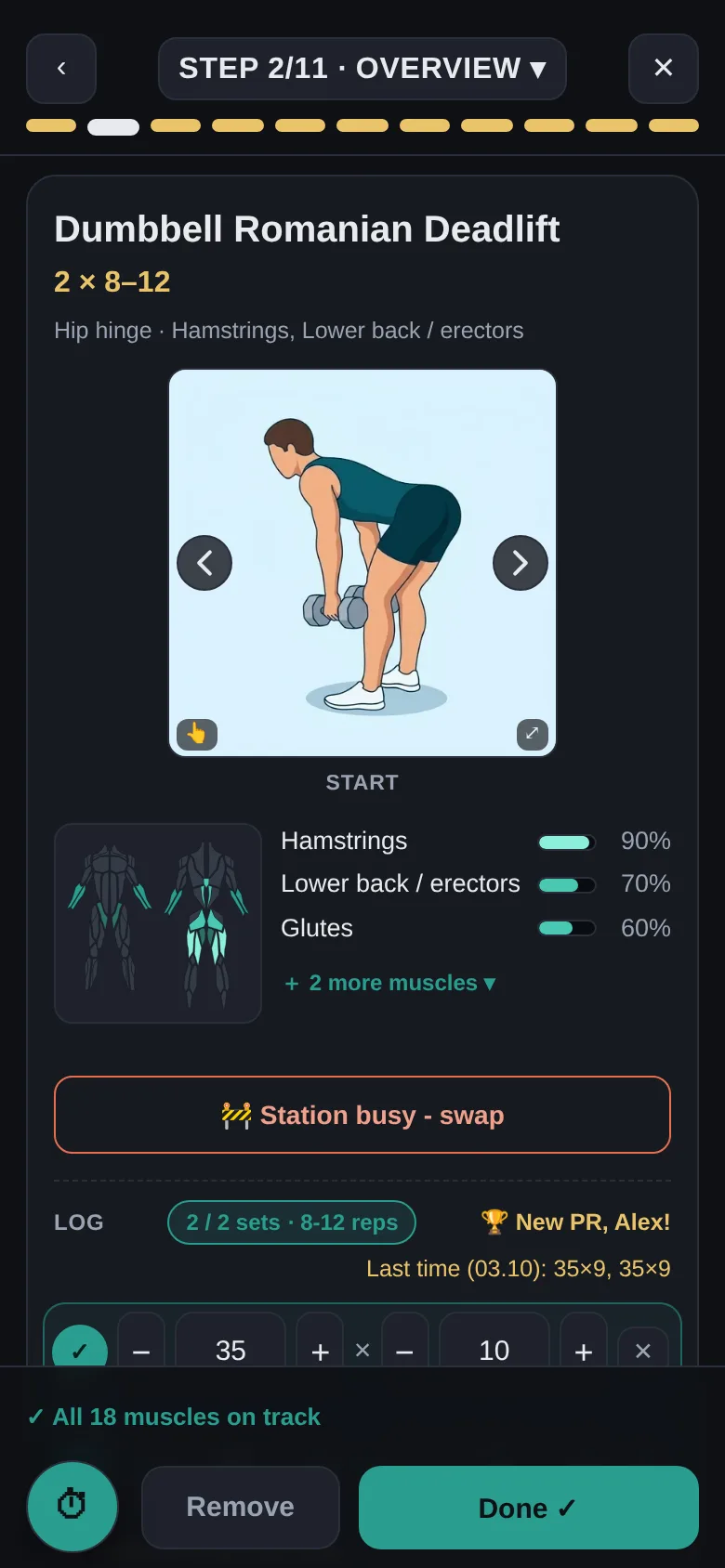
| Hamstrings | 47 | Seated Leg Curl 95%, Lying Leg Curl 95%, Nordic Curl 95% |
| Glutes | 51 | Barbell Hip Thrust 100%, Kettlebell Swing 85%, Cable Glute Kickback 85% |
| Lower back / erectors | 35 | Conventional Deadlift 85%, Good Morning 80%, Back Extension 80% |
| Abs | 66 | Hanging Leg Raises 95%, Ab Wheel Rollout 95%, Twisting Hanging Knee Raises 90% |
| Calves | 42 | Standing Calf Raises 100%, Seated Calf Raises 100%, Leg Press Calf Raises 100% |
| Chest | 23 | Barbell Bench Press 100%, Dumbbell Bench Press 100%, Chest Dips 95% |
| Lats | 29 | Lat Pulldown 100%, Pull-Ups 100%, Close-Grip Pulldown 95% |
| Mid-back / traps | 39 | Barbell Row 100%, T-Bar Row 100%, Seated Cable Row 90% |
| Rear delts | 26 | Face Pull 90%, Reverse Fly 90%, Reverse Pec Deck 90% |
| Front delts | 45 | Overhead Barbell Press 90%, Seated Dumbbell Press 90%, Arnold Press 90% |
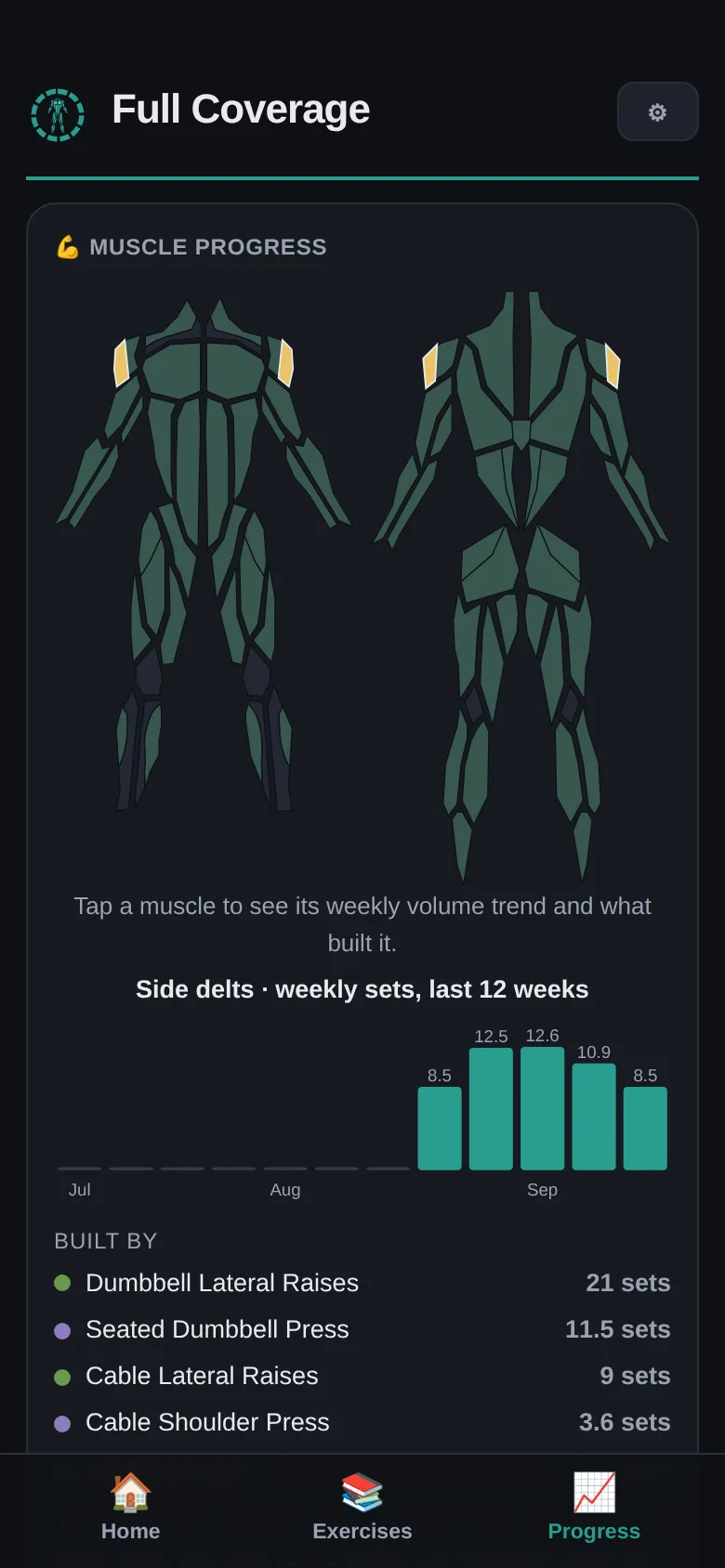
| Side delts | 32 | Dumbbell Lateral Raises 100%, Cable Lateral Raises 100%, Seated Lateral Raises 100% |
| Biceps | 29 | Barbell Curl 90%, Preacher Curl 90%, Dumbbell Curl 90% |
| Triceps | 41 | Skullcrusher 95%, Triceps Pushdown 90%, Overhead Triceps Extension 90% |
| Forearms | 61 | Farmer's Carry 90%, Suitcase Carry 90%, Kettlebell Farmer's Walk 90% |
| Adductors (inner thigh) | 35 | Hip Adduction (Machine) 85%, Copenhagen Plank 85%, Cable Hip Adduction 80% |
| Obliques | 37 | Russian Twist 90%, Cable Woodchop 90%, Hanging Windshield Wipers 85% |
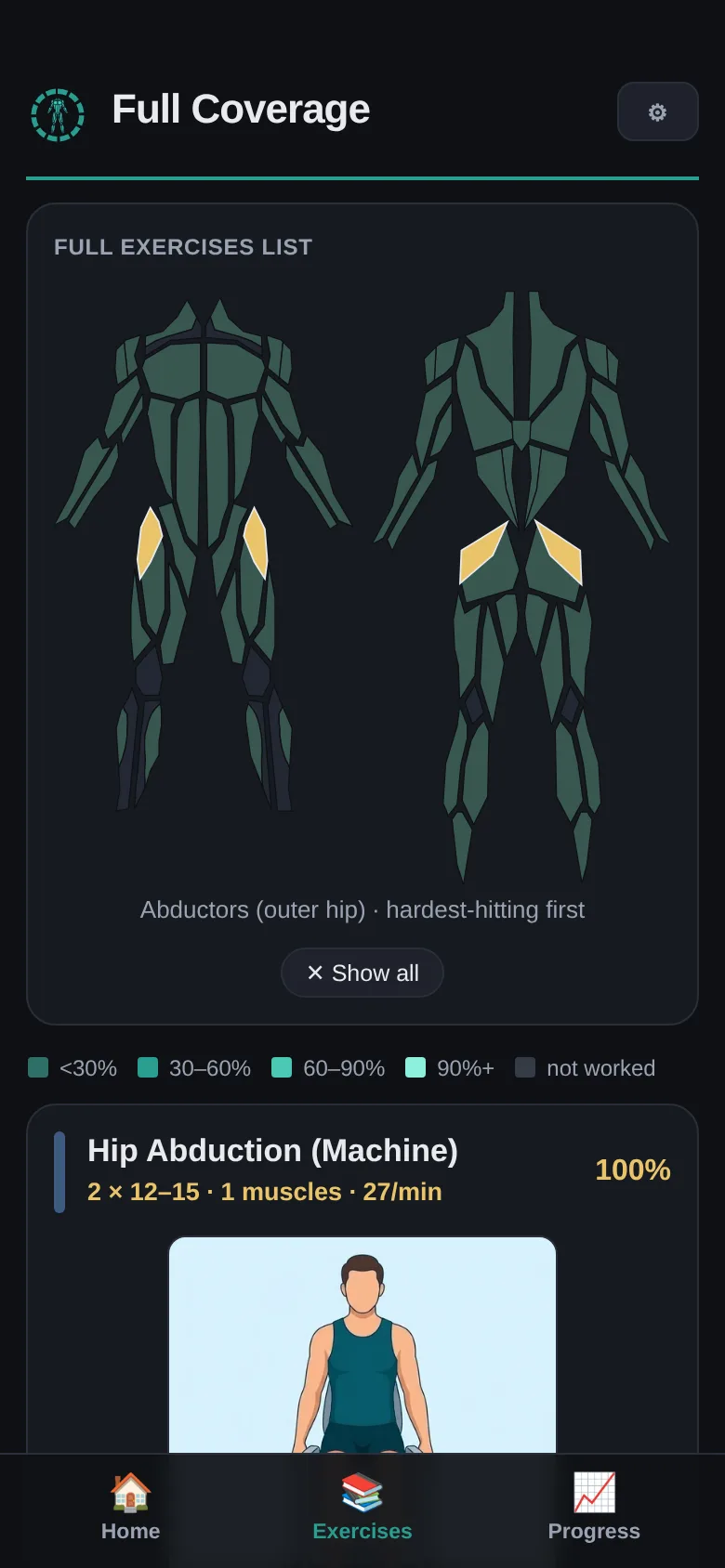
| Abductors (outer hip) | 17 | Hip Abduction (Machine) 100%, Band Lateral Walk 80%, Standing Side Leg Raise 75% |
Two things in that table are worth pausing on. Abductors (outer hip) has the fewest movements of any group in the catalog by a wide margin - which is exactly why it is the group most routines miss entirely. And Abs has the most, which is why nobody misses abs and a great many people over-train them.
How to use this on your own routine
Take the movements you already do, add up each muscle’s percentages, and see what lands under 100. That is the whole method, and it is arithmetic rather than judgement.
You do not have to do it by hand. The coverage checker is free, needs no account, and runs entirely in your browser - tick what you train and it returns the body map, the groups falling short, and the two movements that close the biggest gaps. Nothing is sent anywhere.
Inside the app the same numbers are live: every movement carries its activation profile, the session total updates as you swap, and tapping any muscle lists every exercise that trains it in ranked order. All of that is free - what is paid is the solver that picks the shortest session hitting every target for you.
Related guides
Which Muscles Is Your Workout Missing?
Most routines miss the same handful of muscle groups. Here they are, measured - with what a classic five-lift routine actually delivers to each one.
How Many Exercises Per Workout?
The usual answer is 4-7 exercises. Measured against every muscle group, that leaves a third of them short - and the exercises people add next fix none of it.
How Many Sets Per Muscle Per Week?
The weekly set ranges the research supports, what counts as a set when an exercise only assists a muscle, and the ceiling on what one session delivers.
Adductors and Abductors: Do You Need Them?
The two groups almost every routine skips and almost every lifter dismisses. What they actually do, what your programme gives them, and what closing it costs.