Guides / How Many Exercises Per Workout?
How many exercises per workout, measured
Search this question and you get the same answer everywhere: four to seven exercises. It is good advice about fatigue and it is silent about coverage. Here is what four to seven actually delivers across 18 muscle groups, measured with a real activation model.
By Mike Zino, founder · Updated 2026-08-19
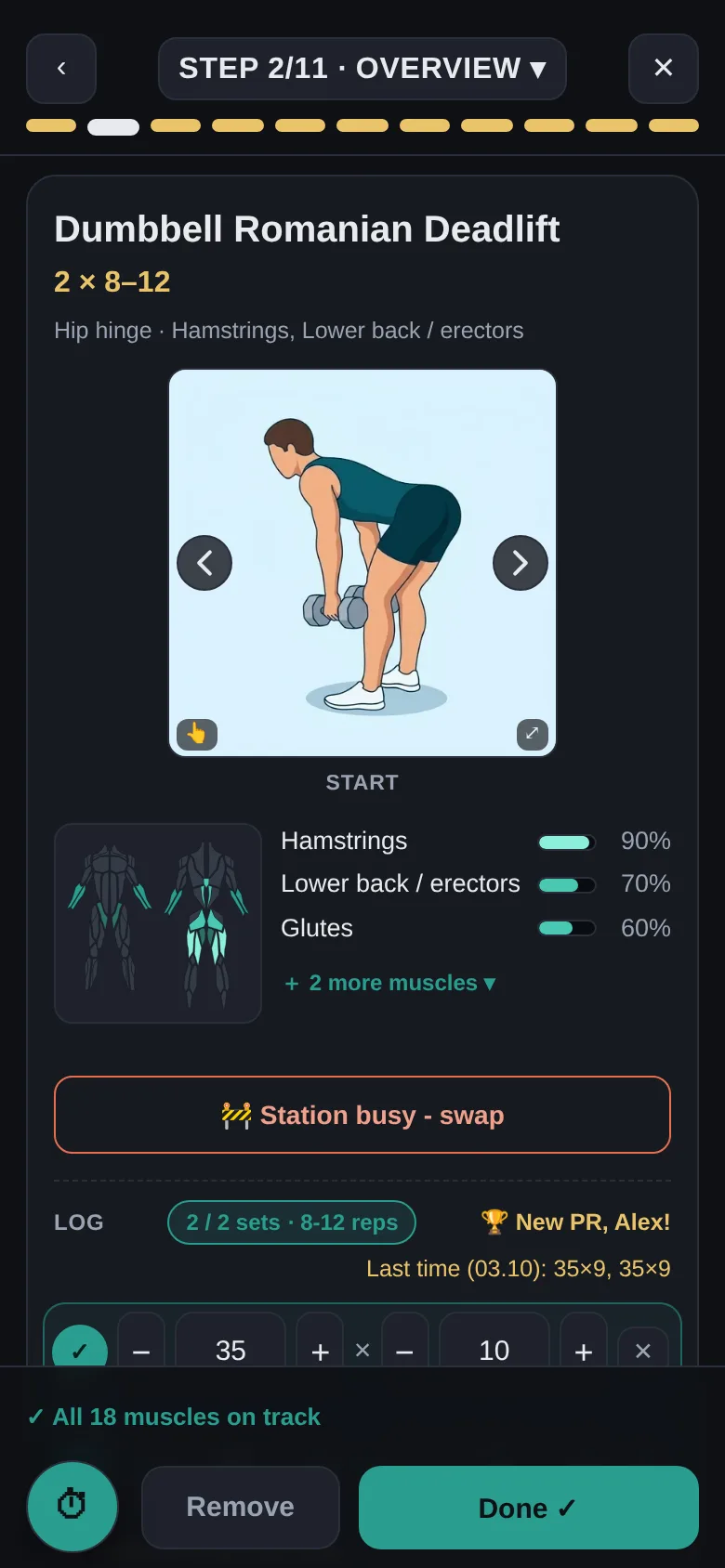
What each exercise buys you
We built up a textbook full-body session one lift at a time and measured, after each one, how many of 18 muscle groups had reached a full session's target.
| Exercises | Added | Groups on target |
|---|---|---|
| 1 | Back squat | 1 |
| 2 | Romanian deadlift | 4 |
| 3 | Bench press | 5 |
| 4 | Lat pulldown | 6 |
| 5 | Seated row | 10 |
| 6 | Overhead press | 12 |
| 7 | Barbell curl | 12 |
| 8 | Triceps pushdown | 12 |
| 11 | + lateral raise, hip adduction, hip abduction | 15 |
| 13 | + calf raise, loaded rotation | 18 |
Two rows matter more than the rest. Compounds are enormously efficient early - lifts five and six add four groups and two groups respectively. And then rows seven and eight, the two exercises almost everybody adds next, add nothing at all. The arms were already covered by the pressing and pulling.
So "4-7" is right about the wrong thing
The standard advice is not wrong on its own terms. Past roughly 11 fractional sets for one muscle in one session, extra work stops showing up in the outcome Remmert 2025, and there is a real fatigue cost to a long session. Nobody should do eighteen exercises.
But "how many exercises" is the wrong question, because the answer depends entirely on which. Six well-chosen compounds get you to 12 of 18. Eight badly chosen ones also get you to 12. The number is not doing the work - the selection is.
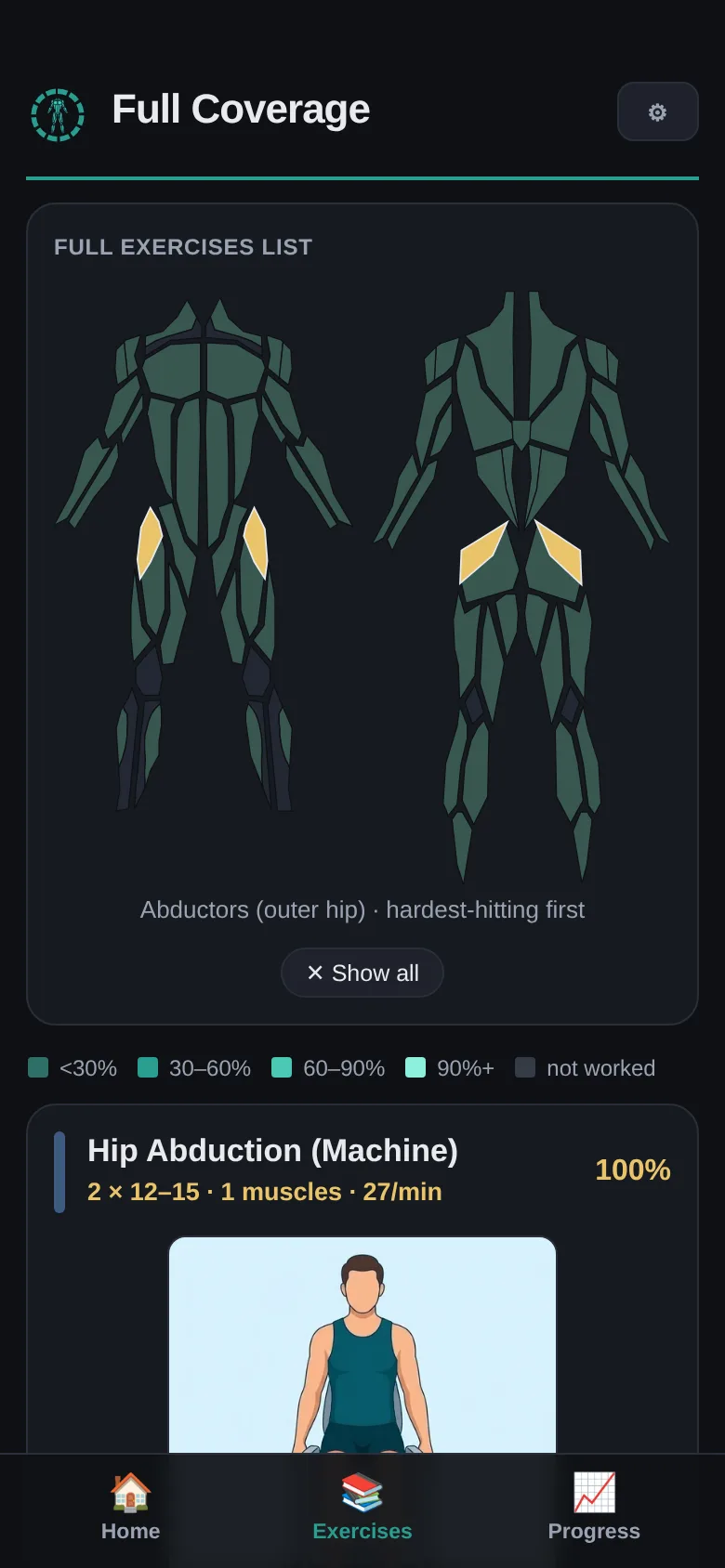
The groups left behind at six are consistent and predictable: Side delts, Calves, Abs, Obliques, Adductors (inner thigh) and Abductors (outer hip). Every one of them is missing for the same reason - no compound in a normal session loads it. That list, and why it is always the same list, is worth its own article.
The honest number
For a complete full-body session - every group at 100% of its per-session target, nothing padded - the answer lands at 11 to 13 exercises, in roughly 39 minutes for the default profile. That is not a target we picked; it is what a solver returns when you ask for the fewest movements that cover everything, and it comes out remarkably stable across levels and equipment.
It is also more exercises and less time than the intuitive alternative, because the extra movements are small, cheap ones. A lateral raise is 3 minutes. A calf raise is 3 minutes. What they buy is two muscle groups going from nothing to covered.
If you train fewer than that, you are not doing something wrong - you are choosing which groups to leave out. The only real mistake is not knowing which ones.
How to pick, rather than count
Three rules do most of the work.
Start with the broadest movements. A squat, a hinge, a horizontal press, a vertical pull and a horizontal row cover more per minute than any other five lifts you could choose. Coverage per minute is the honest ranking, and it is the one the exercise directory sorts by.
Then add only what is genuinely uncovered. Not what is fun, and not what feels underworked - the two are rarely the same muscle. This is exactly where an arm exercise loses to a lateral raise.
Count sets per muscle per week, not exercises per session. The number that predicts growth is weekly volume per muscle Pelland 2025 Schoenfeld 2017, and exercises-per-session is at best a proxy for it. The ranges the research supports are here.
Related guides
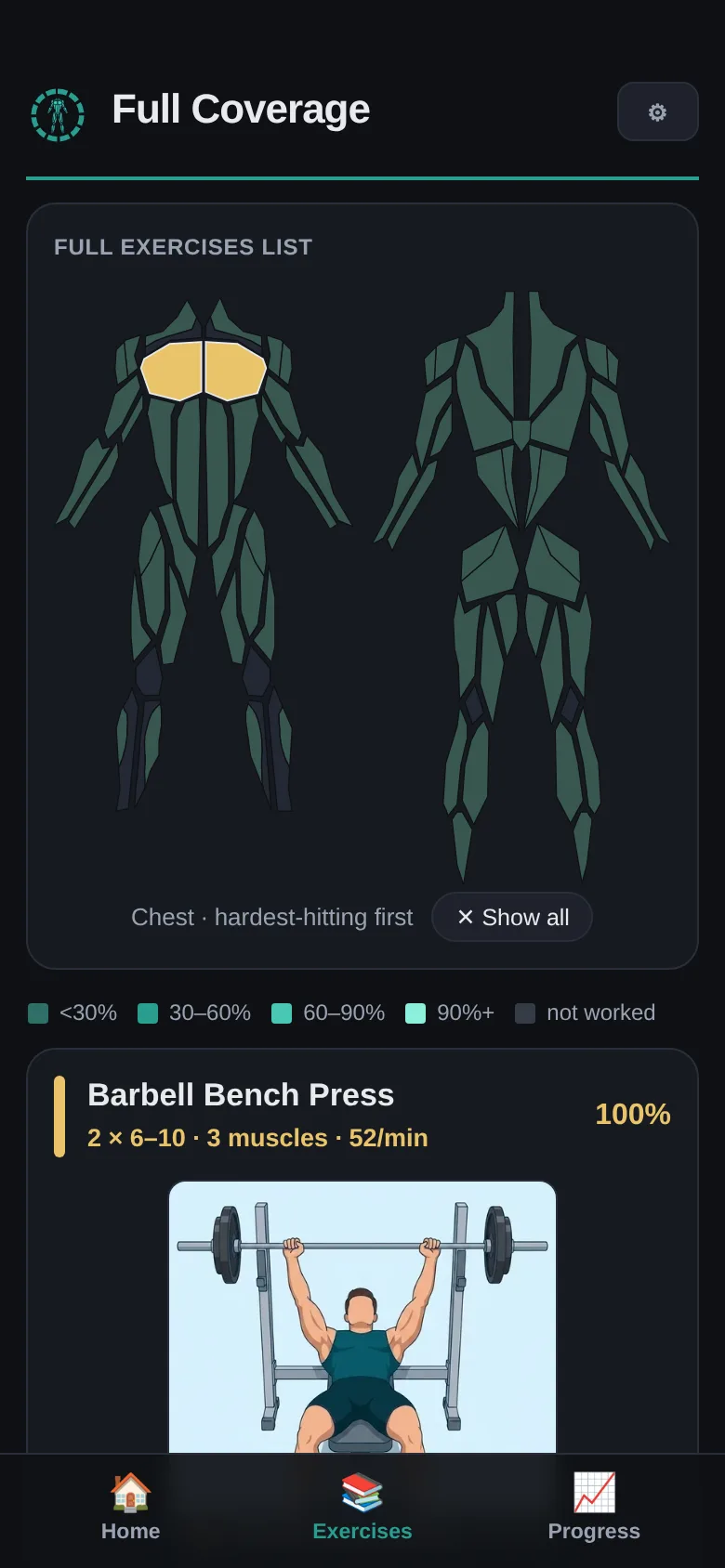
What Muscles Does Each Exercise Work? (With Percentages)
Most answers give you a list of muscle names. This one gives you the share of a session each movement actually delivers, for all 18 groups.
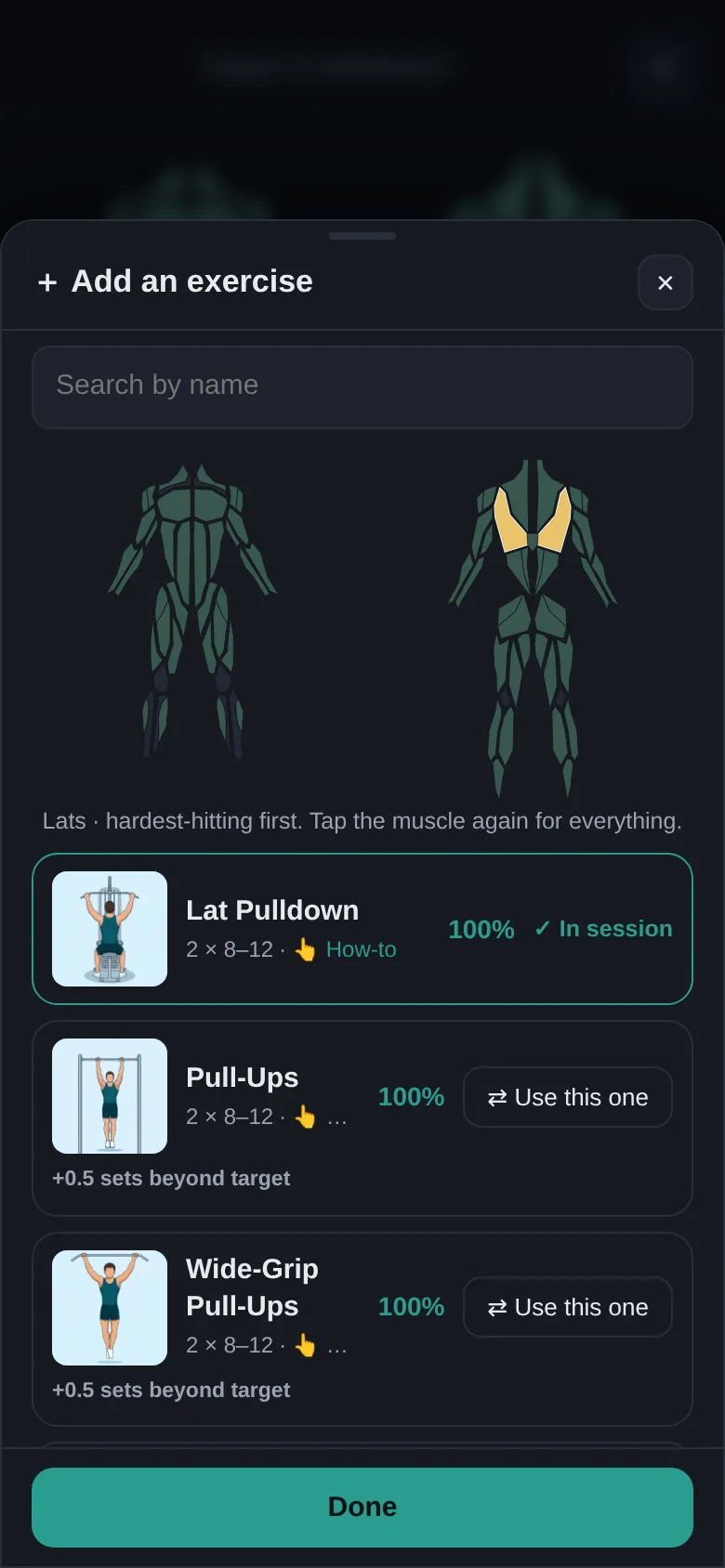
Which Muscles Is Your Workout Missing?
Most routines miss the same handful of muscle groups. Here they are, measured - with what a classic five-lift routine actually delivers to each one.
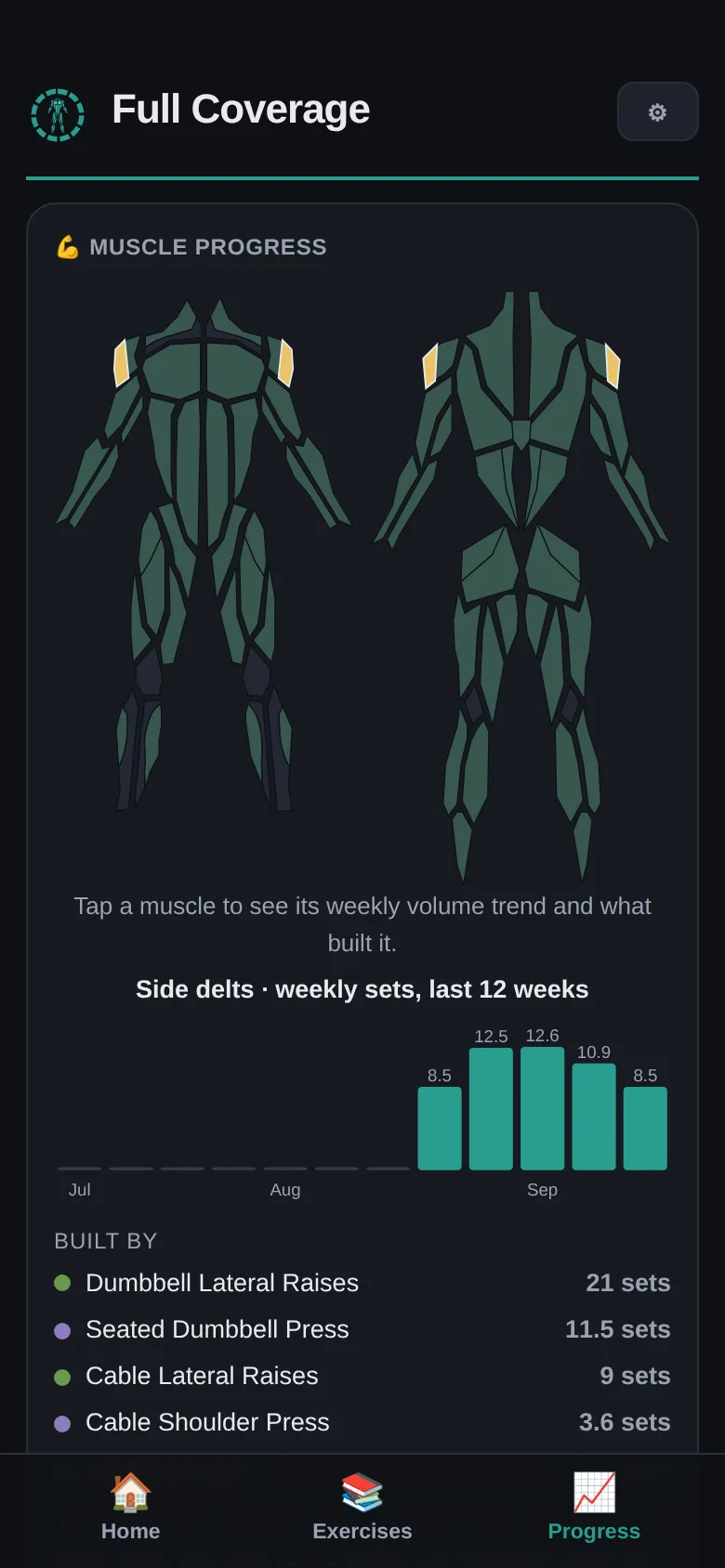
How Many Sets Per Muscle Per Week?
The weekly set ranges the research supports, what counts as a set when an exercise only assists a muscle, and the ceiling on what one session delivers.
Adductors and Abductors: Do You Need Them?
The two groups almost every routine skips and almost every lifter dismisses. What they actually do, what your programme gives them, and what closing it costs.