Guides / How Many Sets Per Muscle Per Week?
How many sets per muscle per week?
This is the most-asked question in training and it has a real answer, with a real shape: more sets produce more growth, with diminishing returns, up to a point where the evidence stops. Here are the numbers, where each one comes from, and the two things that change the answer for you.
By Mike Zino, founder · Updated 2026-08-07
The short answer
For muscle growth, the ranges the research supports look like this:
- Under 5 sets a week produces real gains, especially if you are new, but it is not where the best results were found. It is enough to hold what you already have Spiering 2021.
- 5 to 9 sets a week does measurably better.
- 9 to 10 sets a week and above is where the strongest results appeared - an effect size of 0.46 against 0.32 below it Schoenfeld 2017.
More is not simply better without limit. The largest analysis to date, covering 67 studies and 2,058 participants, reports that gains keep rising with volume but that “both best-fit models suggest diminishing returns” Pelland 2025. Each extra set buys less than the one before it, and nobody has published the exact curve, which is why you should be suspicious of any app or article that quotes you a precise multiplier for going from two sessions to three.
What counts as a set
This is where most set-counting goes wrong. If you bench press, your chest is doing the work and your triceps are assisting. Counting that as a full set of triceps overstates it; counting it as nothing understates it.
The best-supported method splits the difference: an assisting muscle counts as a fraction of a set. When three counting methods were compared - full credit, half credit, and no credit - the evidence for half credit was strongest, and the authors concluded that distinguishing direct from indirect work “appears essential for predicting adaptations” Pelland 2025.
So three sets of bench press is roughly three sets of chest and one and a half of triceps. Do that honestly across a week and most people discover their arms are getting far more work than their training log suggests, and their calves and side delts far less.
There is a ceiling per session
You cannot bank a week of volume in one afternoon. Past roughly 11 fractional sets for a single muscle in a single session, the extra work stops producing a detectable advantage Remmert 2025.
That is the practical reason weekly volume and session frequency are linked at all. If you want 12 sets of quads a week and one session can usefully absorb about 11 for that muscle, you are not going to get there in one visit no matter how long you stay.
Two things that change the answer
You are dieting. The instinct is to cut training volume when calories drop. The evidence points the other way: a review of resistance training during caloric restriction found that programmes which reduced volume preserved less lean mass than those that held or raised it Roth 2022. That same review is careful to say higher volume is not proven better for sparing muscle - the finding is about not cutting back, which is a different and more useful claim.
You are training for strength rather than size. The volume story is weaker here. Diminishing returns for strength are “considerably more pronounced” Pelland 2025, while training frequency has a consistent effect of its own that it does not have for hypertrophy. For strength, spreading the work across more sessions matters more than piling more sets into each one.
How to count yours without a spreadsheet
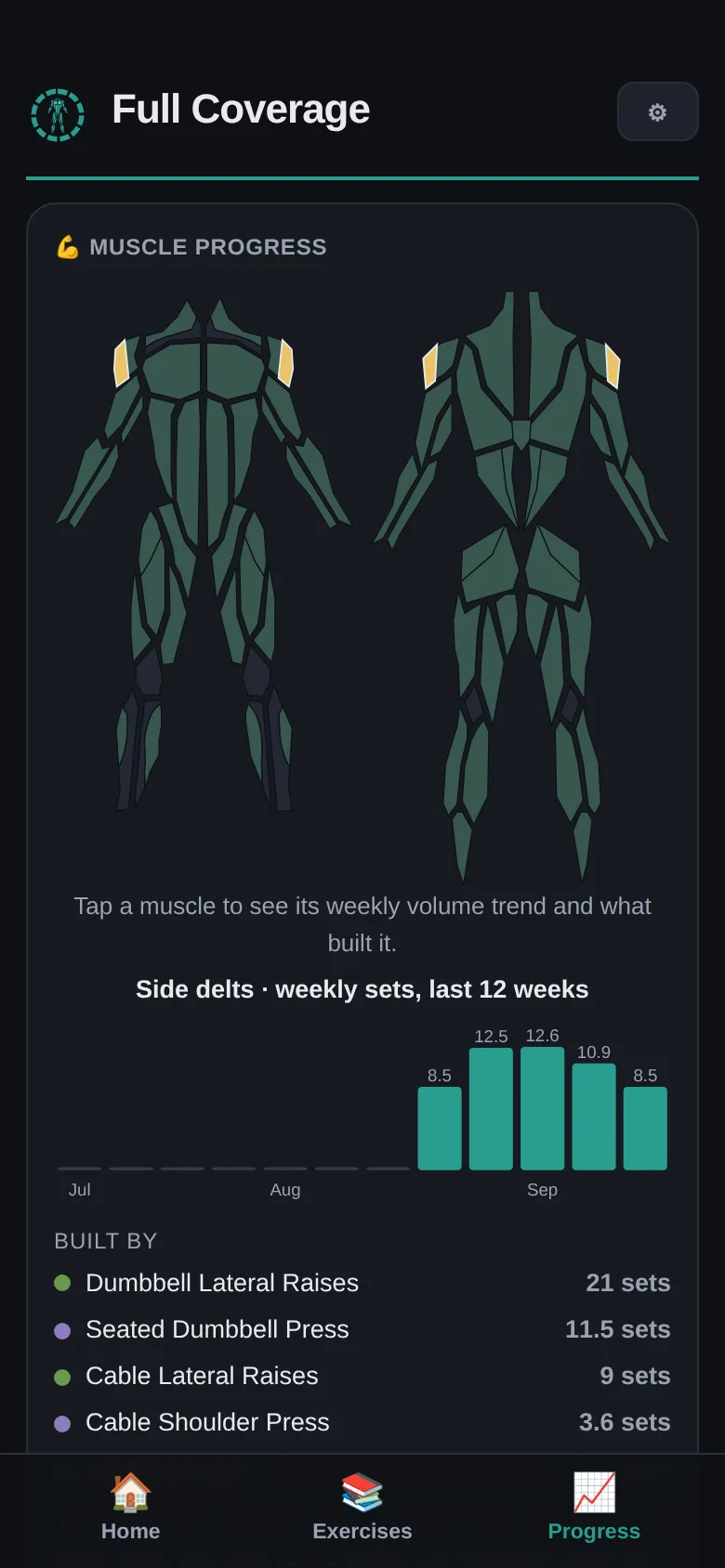
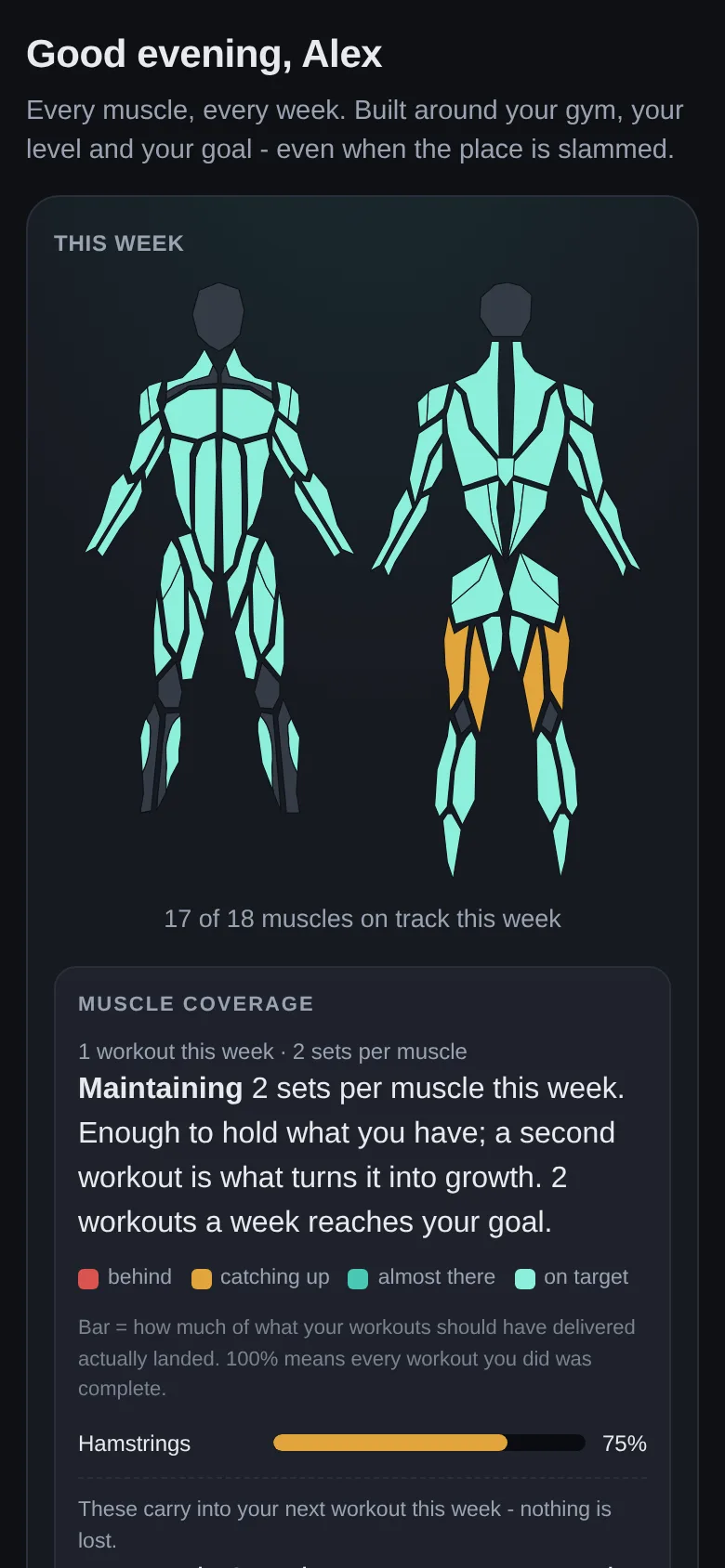
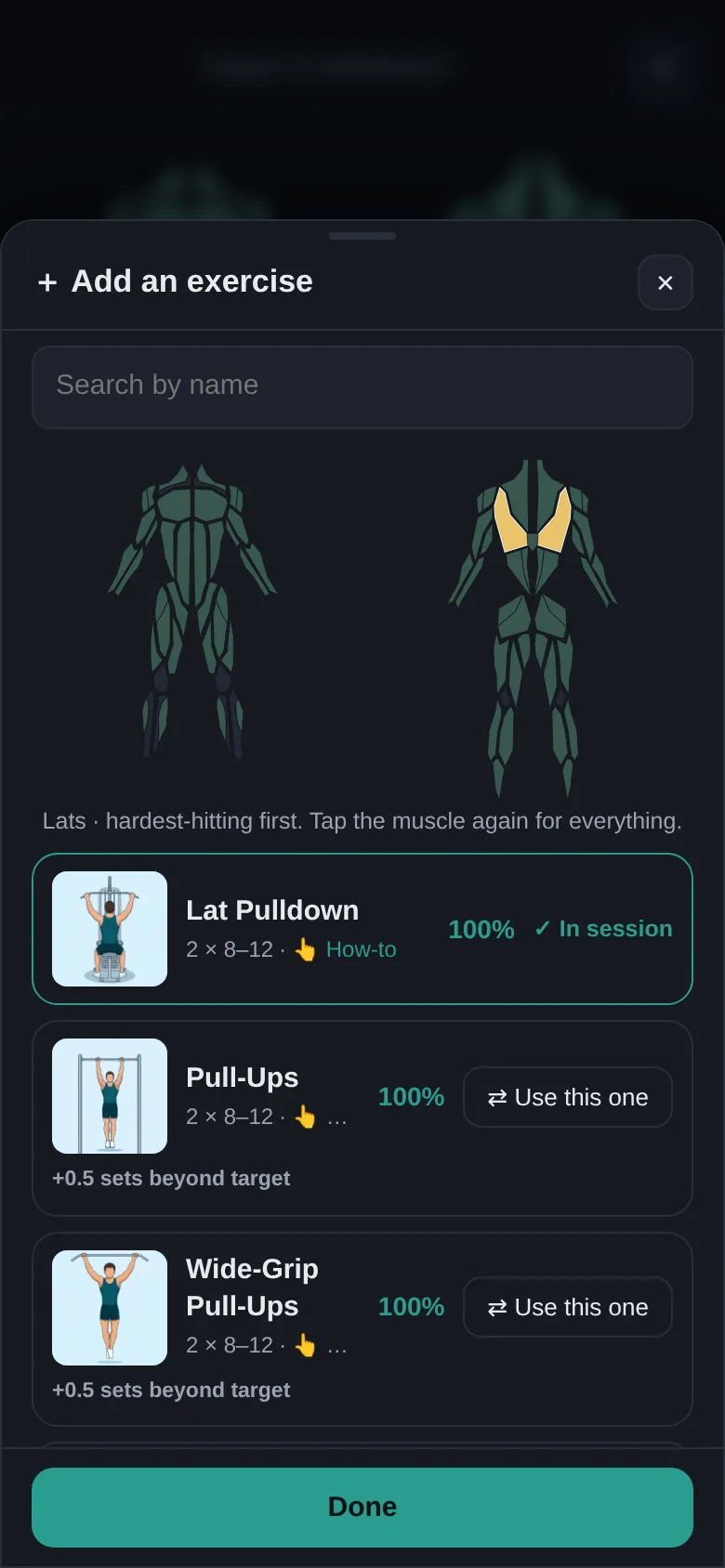
Sets per muscle per week is only actionable if something is counting them, and counting them by hand means assigning a fraction to every assisting muscle in every exercise you did. That is exactly the arithmetic Full Coverage does automatically: every movement in the catalog carries a per-muscle activation figure, a set is credited in full, half or a quarter depending on the role that muscle plays, and the weekly total is shown per muscle with the exercises that produced it.
Every number above is on our evidence page with the paper it came from, including the one that limits our own method.
Related guides
What Muscles Does Each Exercise Work? (With Percentages)
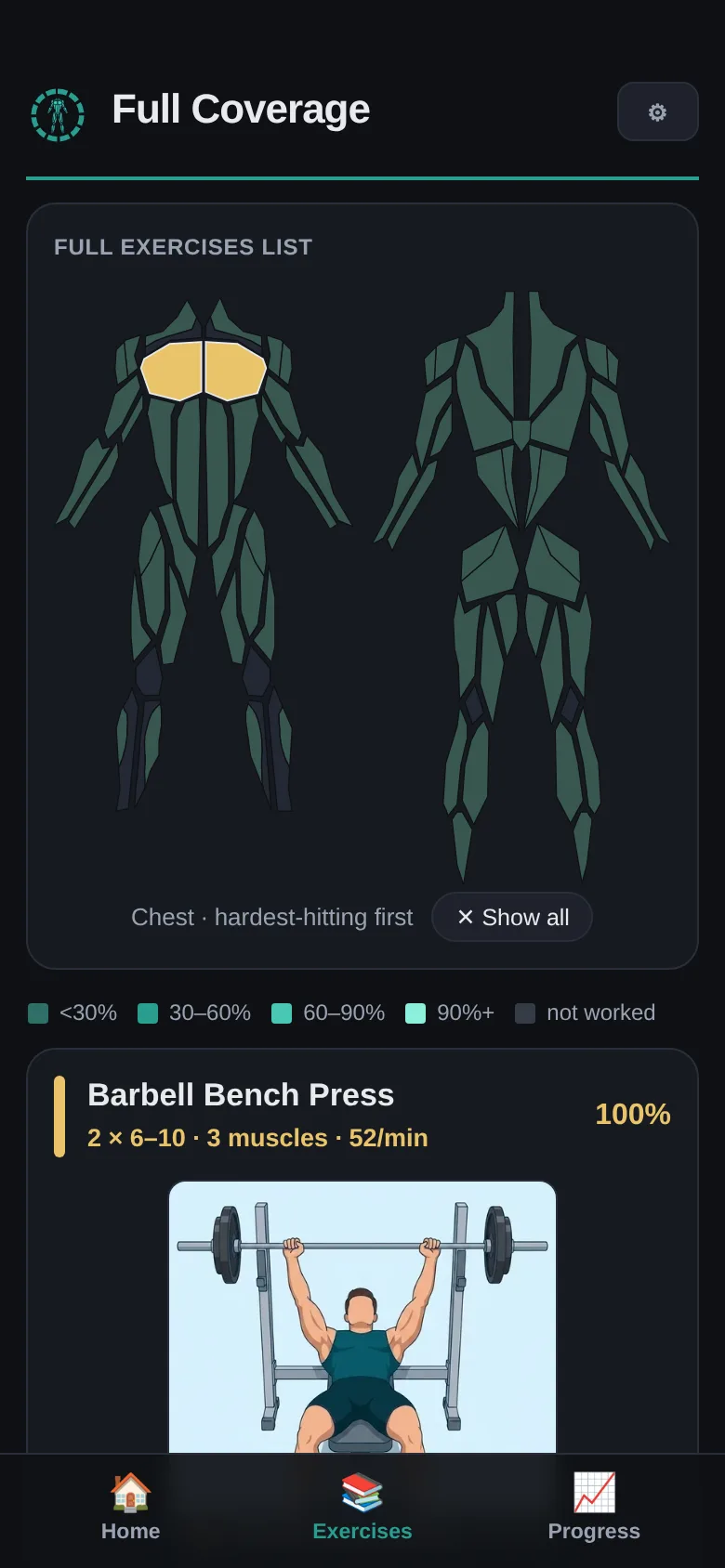
Most answers give you a list of muscle names. This one gives you the share of a session each movement actually delivers, for all 18 groups.
How Often Should You Train Each Muscle?
Training frequency research, plainly: once weekly volume is matched, how you spread it out barely changes growth. What frequency is actually for.
Which Muscles Is Your Workout Missing?
Most routines miss the same handful of muscle groups. Here they are, measured - with what a classic five-lift routine actually delivers to each one.