Guides / Adductors and Abductors: Do You Need Them?
Do you actually need to train your adductors and abductors?
It is a fair question, and it is usually asked in a tone that expects the answer no. The inner thigh and the outer hip are the two groups a barbell routine misses most reliably, and the two a lifter is most confident they do not need. One of those beliefs is wrong for a reason you can measure, and the other is wrong for a reason you can read in an anatomy paper.
By Mike Zino, founder · Updated 2026-09-27
First, what your routine actually gives them
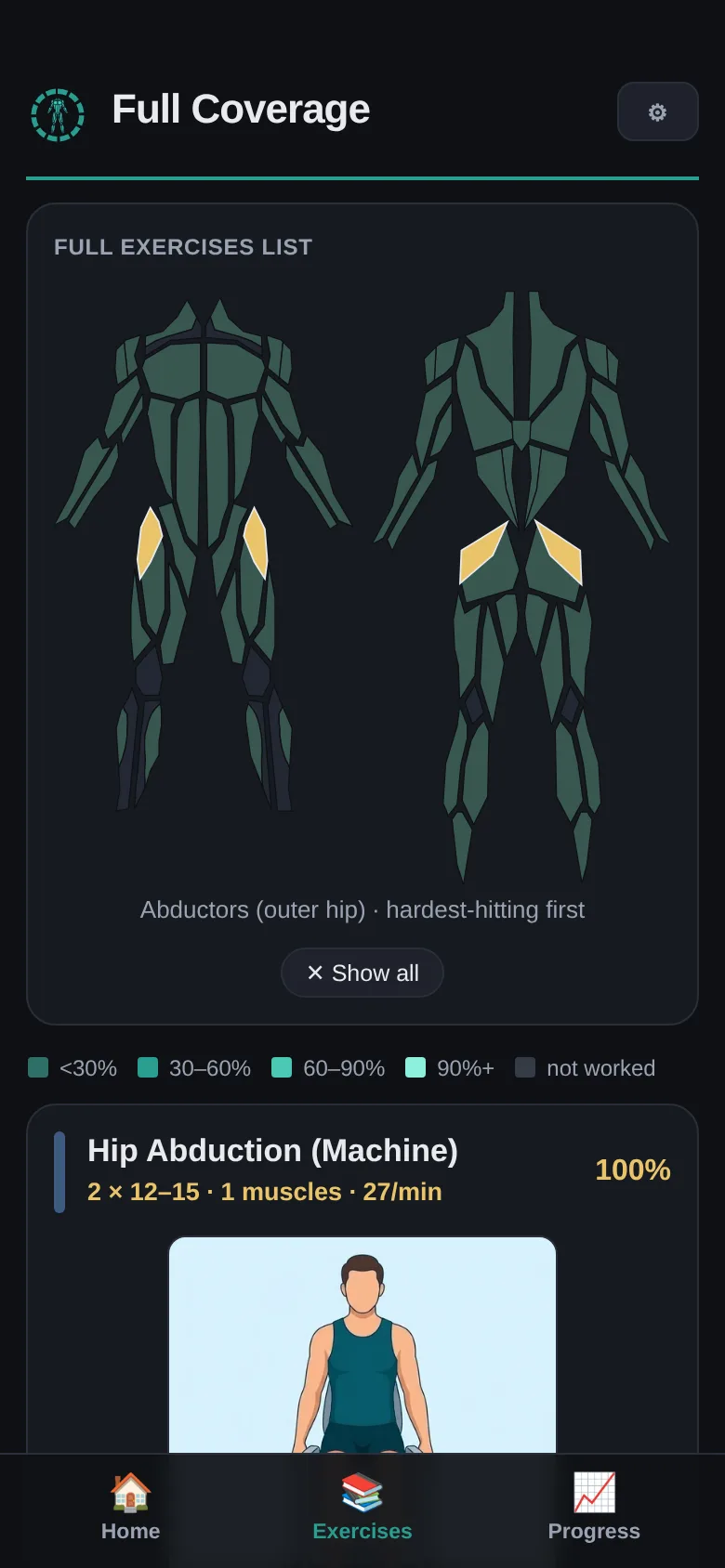
Take the routine most beginner programmes recommend: back squat, Romanian deadlift, bench press, lat pulldown, seated row. Run it through the same engine the app uses and the Adductors (inner thigh) finish on 60% of one session’s target. The Abductors (outer hip) finish on 0%.
Those two numbers are different kinds of problem and they deserve different answers. 60% is a muscle that is being worked and not finished - the squat and the deadlift really are training it, just not to target. 0% is a muscle that nothing in the session touches at all. So the honest form of the question is not "do I need these", it is "is 60% enough, and is nothing acceptable".
Worth saying plainly before either: a muscle that receives no stimulus does not grow or get stronger, and the published floor for a working dose is around four hard sets per muscle per week Iversen 2021. That is the bar. The full measurement of that routine, group by group, is its own article.
The adductors are barely adductors
The name is doing the damage. "Adductor" describes squeezing your legs together, which is not something you do under load outside a machine, so the group reads as decorative. The anatomy says otherwise twice over.
It is not a small muscle. As a group the adductors are the largest muscle mass in the lower body after the glutes, and adductor magnus alone is the second-largest muscle in the whole lower limb Takizawa 2014. Skipping it is not skipping a detail.
And it is mostly a hip extensor. Imaging of living adults found the portions making up over 80% of adductor magnus’s volume and cross-section have a longer lever for hip extension than for adduction Takahashi 2025. It was named after its smaller job. The question "who needs adduction" turns out not to be a question about adduction.
So your squat already trains it - and how much depends on how you squat. Ten weeks of full-depth squats grew the adductors 6.2%; the same ten weeks at half depth grew them 2.7%, while quadriceps and hamstring growth was much the same either way Kubo 2019. That is the single most useful fact on this page, and notice that it cuts against us as much as for us: the squat is adductor work. It is also invisible to any app that files a squat under "quads" - a per-muscle model is what lets depth change a number instead of changing nothing.
There is one more reason, and it is the only injury claim on this page: direct adductor work is the version of this with a randomised trial behind it. Across 35 semi-professional football teams, an adductor strengthening programme cut self-reported groin problems by about 41% over a season Harøy 2019. This app is not a rehab programme and does not prescribe that protocol - but "nothing else does this job" is a stronger claim when something has actually been tested.
The abductors are a missing plane, not a missing muscle
Gluteus medius and minimus sit on the outside of the hip. Their textbook job is moving the leg away from the midline, which sounds equally decorative - but their real job is stopping the pelvis dropping when you stand on one leg. That is every step you take, every stair, every stride of a run.
Here is why a normal programme gives them exactly nothing. A barbell session moves almost entirely front-to-back: squat, hinge, press, pull. The outer hip works side-to-side. It is not that the exercises are poorly chosen - it is that an entire plane of movement is absent, and nothing in that plane is a lift anyone builds a programme around. The catalog makes the same point from the other end: Abductors (outer hip) has 16 movements that train it, fewer than any other group and barely half the next-smallest. There is nothing for it to hide behind.
Now the part most articles overstate, so we will not. Adding hip strengthening to knee strengthening does beat knee work alone for kneecap pain, across 14 trials and 673 participants Nascimento 2018 - though the authors note the benefit arrived without a measured change in strength, so the mechanism is unsettled. And the popular claim above it - that weak abductors cause knee pain - rests on studies of people who already have it, not on studies that watched healthy people and waited Barton 2013. It is a comfortable story and the evidence for it is thinner than you are usually told.
They earn their place on coverage and on function: a group you use every time you stand on one leg, which your programme trains zero percent of. That is enough of a reason. It does not need the injury story.
What closing both actually costs
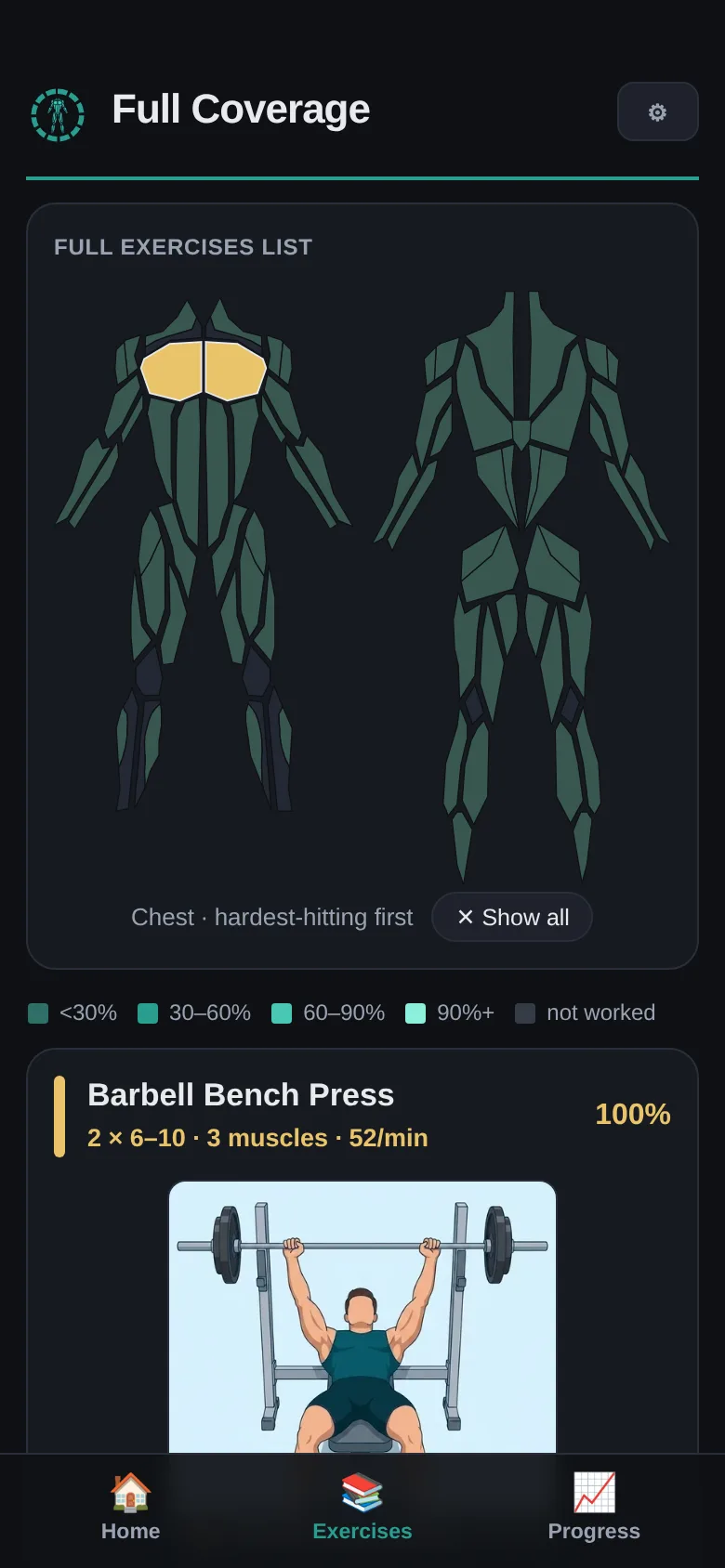
This is the part that decides it, because the objection is really about time. Add one hip adduction movement and one hip abduction movement to those five lifts and, measured on the same engine: the Adductors (inner thigh) go from 60% to 145% of target, the Abductors (outer hip) from 0% to 100%, and the session goes from 10 of 18 groups on target to 12. The clock goes from 18 minutes of working time to 25.
Seven minutes, two machines that are almost always free in a crowded gym, and they are antagonists sharing one apparatus - you swing the pads round rather than walking anywhere. If seven minutes for two whole muscle groups is a bad trade, most of what people add to a session is a far worse one: the same measurement shows that adding a barbell curl and a triceps pushdown to a six-lift routine moves the on-target count by zero, because the compounds had already covered both arms.
That is the real shape of the answer. The two groups people cut are cheap and uncovered; the exercises people add instead are expensive and redundant.
The short version: the Adductors (inner thigh) are the second-largest muscle mass in your legs and mostly a hip extensor, so your squat trains them and depth decides how much. The Abductors (outer hip) hold your pelvis level on one leg and a front-to-back programme gives them nothing at all. Two movements and about seven minutes close both. Skip them if you want - but skip them knowing the number, not the name.
Related guides
Which Muscles Is Your Workout Missing?
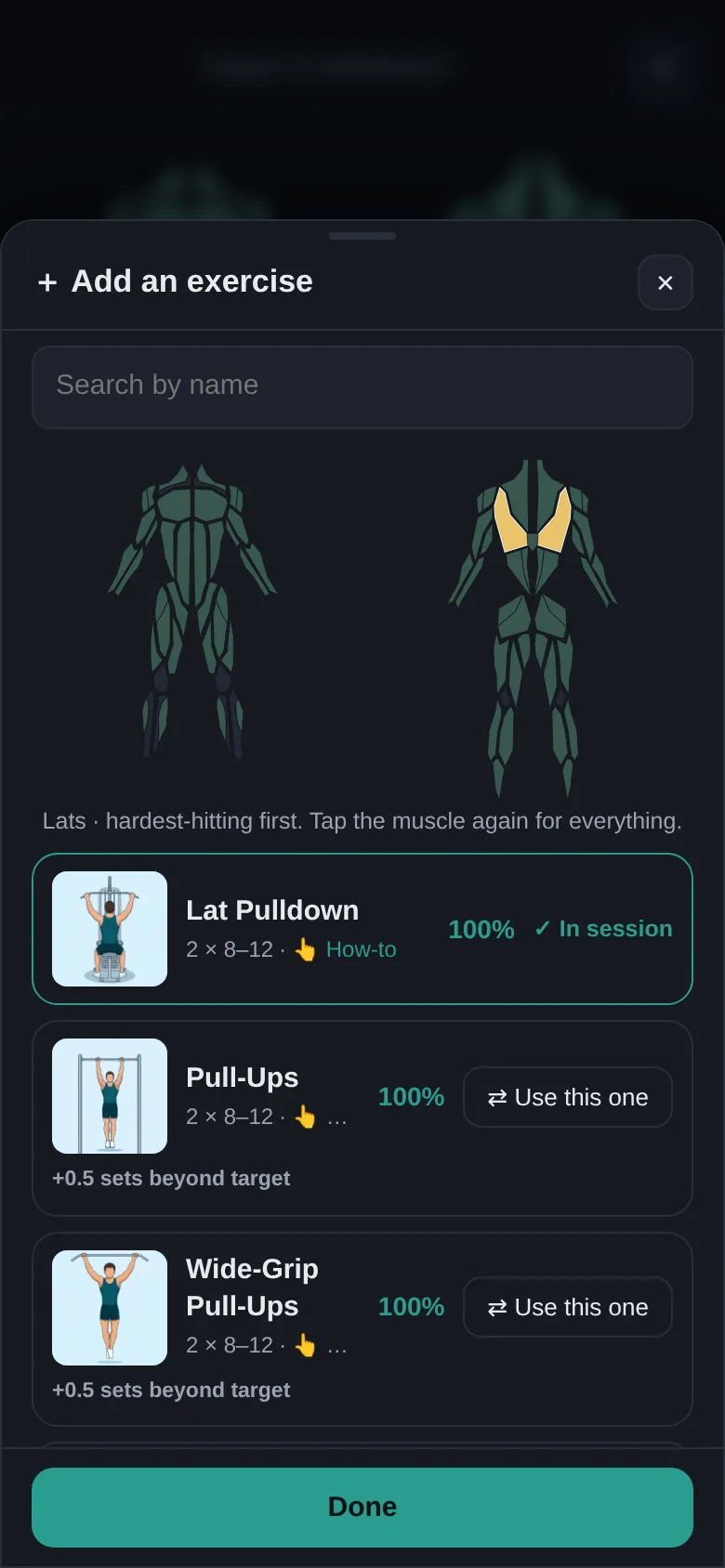
Most routines miss the same handful of muscle groups. Here they are, measured - with what a classic five-lift routine actually delivers to each one.
What Muscles Does Each Exercise Work? (With Percentages)
Most answers give you a list of muscle names. This one gives you the share of a session each movement actually delivers, for all 18 groups.
How Many Exercises Per Workout?
The usual answer is 4-7 exercises. Measured against every muscle group, that leaves a third of them short - and the exercises people add next fix none of it.