Guides / Hevy Alternatives: What a Workout Log Cannot Tell You
Hevy alternatives, and the one thing a log cannot do
This is not an article about Hevy being bad. It is very good at the job it does, it is cheap, and its free tier is genuinely usable. It is an article about a limit every workout log shares, including the ones that cost four times as much - and about what it takes to get past it.
By Mike Zino, founder · Updated 2026-09-08
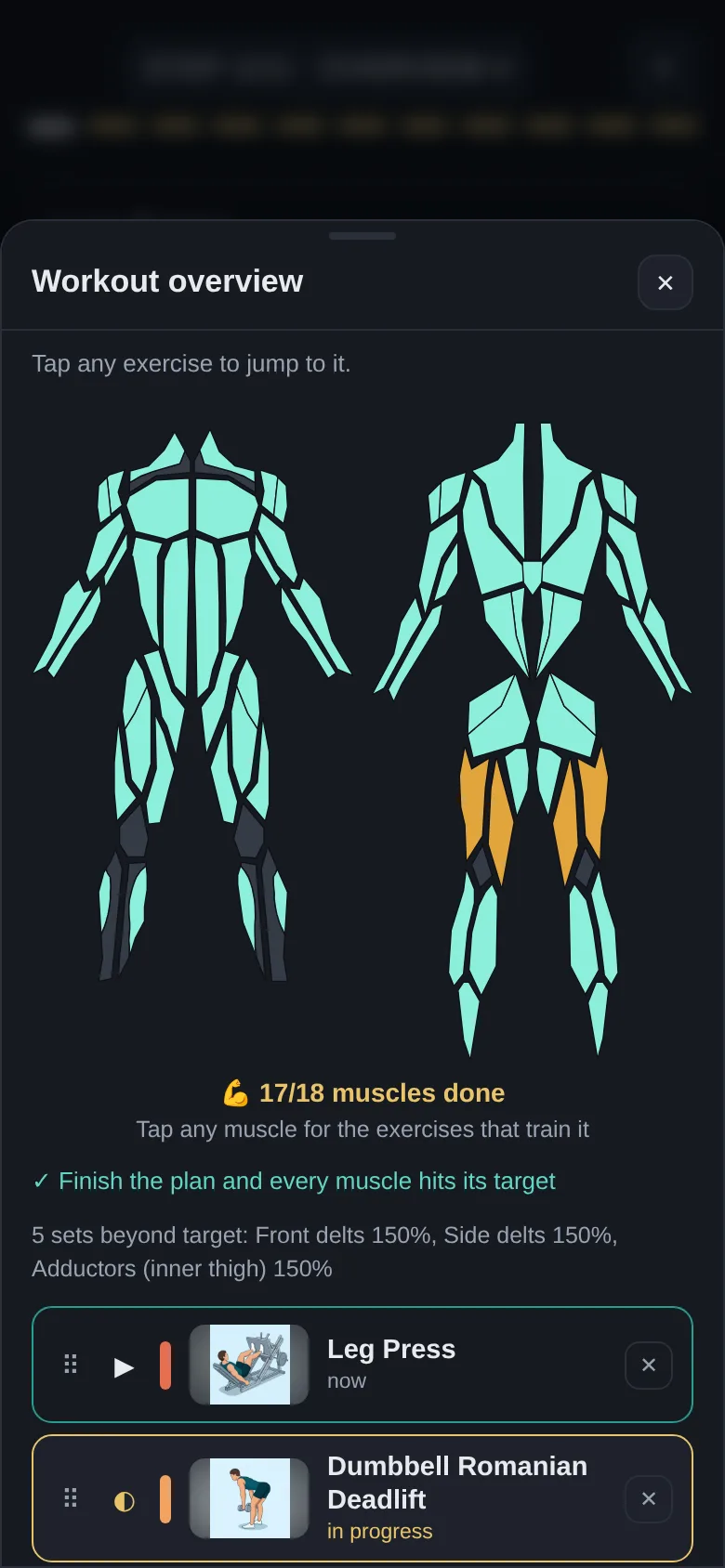
What Hevy is genuinely good at
Worth saying plainly, because the rest of this article is a criticism of one specific thing. Hevy is a fast, well-built logger. Starting a workout takes two taps, the rest timer is right, plate maths is right, the history is searchable, and the social side gets people to train who otherwise would not. At $2.99 a month, $23.99 a year or $74.99 once, it is also among the cheapest paid tiers in the category - roughly a fifth of what Fitbod charges.
Strong is the same proposition with a different free line drawn: its App Store listing states that “The free version of Strong can save unlimited workouts, but is limited to 3 custom routines.”, against $4.99 a month or $29.99 a year. Hevy does not publish its free limits as a number, but its own Pro pitch is “unlimited routines, unlimited graph history, unlimited custom exercises” - which is the vendor telling you which three things the free tier caps. Hevy’s figures checked 2026-09-08, Strong’s 2026-09-08.
If what you want is a record of what you lifted, either one is a good answer and you can stop reading here.
The limit: one exercise, one muscle
Every workout log builds its “sets per muscle group” chart the same way, because it is the only way available to it: each exercise is filed under one primary muscle, and every set of that exercise is credited there. A barbell row is three sets of Back. A squat is three sets of Legs.
That is not a bug in the app. It is the consequence of storing exercises as names rather than as activation profiles. But it means the chart answers a narrower question than the one you are asking it. You want to know whether your rear delts got trained this week. The chart can only tell you whether you did an exercise filed under rear delts.
What that costs, measured
Here is a textbook full-body session - back squat, bench press, barbell row, overhead press, Romanian deadlift, barbell curl, triceps pushdown, hanging leg raises. Eight movements, sixteen prescribed sets, and every one of them logged perfectly.
The middle column is what a primary-muscle chart reports. The right column is the same session read through a per-muscle activation model, counting an assisting muscle as a fraction of a set Pelland 2025. Both in sets; the session target is two sets per group.
| Muscle group | A log’s chart | Measured | |
|---|---|---|---|
| Quads | 2 | 2 | |
| Hamstrings | 2 | 2.5 | |
| Glutes | 0 | 2 | trained, invisible |
| Lower back / erectors | 0 | 3.5 | trained, invisible |
| Abs | 2 | 3 | |
| Calves | 0 | 0 | genuinely missing |
| Chest | 2 | 2 | |
| Lats | 0 | 1 | trained, invisible |
| Mid-back / traps | 2 | 2.5 | |
| Rear delts | 0 | 1 | trained, invisible |
| Front delts | 2 | 3 | |
| Side delts | 0 | 1 | trained, invisible |
| Biceps | 2 | 3 | |
| Triceps | 2 | 4 | |
| Forearms | 0 | 2.5 | trained, invisible |
| Adductors (inner thigh) | 0 | 1.5 | trained, invisible |
| Obliques | 0 | 1 | trained, invisible |
| Abductors (outer hip) | 0 | 0 | genuinely missing |
The chart shows ten of 18 groups at zero. Only two of them really are. The glutes take a full session’s worth from the squat and the Romanian deadlift. The lower back takes more than the target on its own. The forearms take two and a half sets from gripping everything else. None of that appears in a log, because none of those exercises is filed under those muscles.
The error runs the other way too, and it matters more. Calves and Abductors (outer hip) are the two groups this session genuinely never touches - and on the chart they look exactly like the eight that are fine. A reader acting on that chart has ten problems to solve and no way to tell which two are real.
What a coverage model does instead
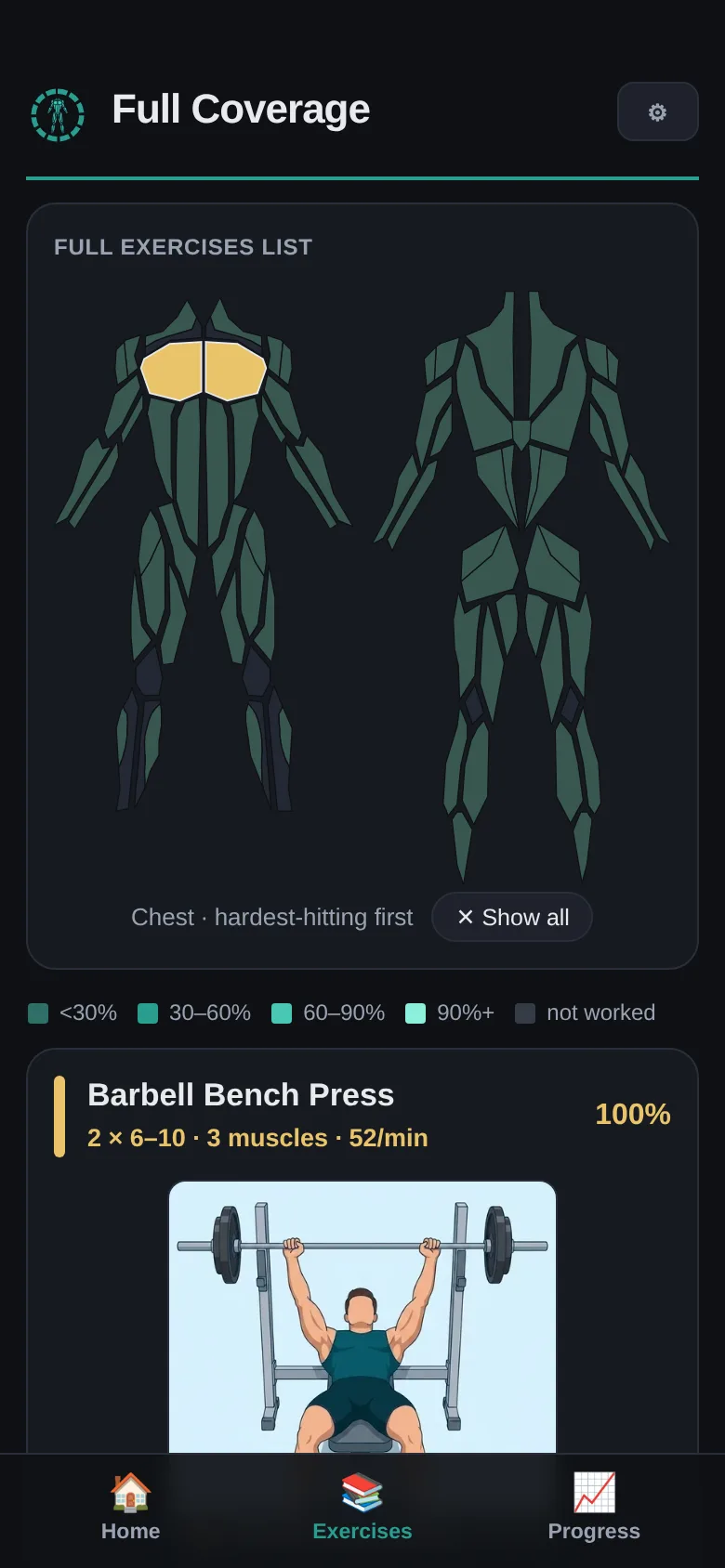
Given the same profile, this app composes 11 to 13 movements that put every one of the 18 groups on target - eleven exercises and twenty-two sets for the profile above, against the template’s eight and sixteen. Six extra sets is the honest price, and it is not the interesting part.
The interesting part is which six. The template’s gaps are calves, hip abductors, side delts, rear delts and lats - and the exercises people add when they feel a session is thin are curls and pushdowns, which the template already covers twice over. That is the failure mode: not too little work, but work aimed at the groups that were already fine Remmert 2025.
You do not need a subscription, or an account, to check this against your own routine. The coverage checker takes the movements you already train and returns the same reading, entirely in your browser.
Comparing the three on what actually differs
Prices as published, each checked on the date shown. Everything below is about the free tier, because that is what most people will actually live in.
| Hevy | Strong | JEFIT | Full Coverage | |
|---|---|---|---|---|
| Paid monthly | $2.99 | $4.99 | $12.99 | $4.99 |
| Paid yearly | $23.99 | $29.99 | $69.99 | $29 |
| One-time | $74.99 | $99.99 | – | $79 |
| Free tier caps | routines, graph history and custom exercises | 3 custom routines | ad-supported | nothing you can see |
| Per-muscle activation published | no | no | no | every movement |
| Tells you what a session missed | no | no | no | free |
The last two rows are the whole comparison. The first four are close enough that price should not decide it.
Checked against each vendor's own listing, on its own date: Hevy 2026-09-08, Strong 2026-09-08, JEFIT 2026-08-06.
Which one you should actually use
We built one of these, so weigh this accordingly - but the honest version is that they answer different questions.
Stay with Hevy or Strong if you follow a programme somebody else wrote and you want a fast, pleasant record of it. A coverage model adds nothing to a session you are not choosing.
Look at this instead if you pick your own exercises, train around a busy gym, or have ever finished a week without knowing whether it was complete. Everything you can read stays free - every activation figure, the coverage map, the whole catalog of 228 movements, and a session you build and reorder yourself. What is paid is the automation: the solver that composes the shortest session hitting every target, and the ranked repair when a swap leaves a muscle short. Every new account gets 14 days of it without a card.
What we are not: a social feed, a programme library, or a 270-versus-1,400 exercise database. Every activation figure here is hand-calibrated, and we would rather publish fewer numbers we can defend.
The one-line version: a log tells you what you did. It cannot tell you what you missed, because it never knew what a complete session was.
Related guides
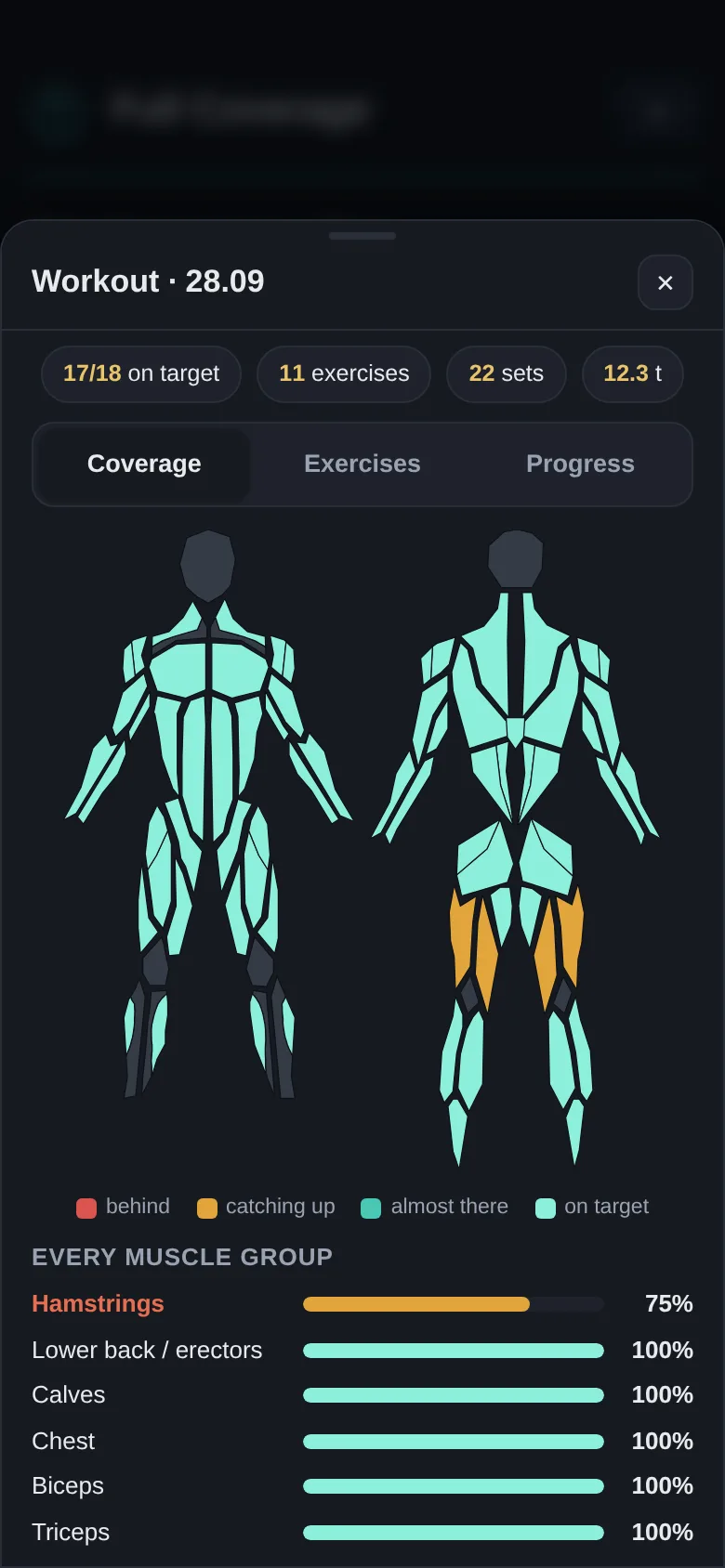
Muscle Heatmap Apps, and the Session They Cannot See
Muscle maps colour what you already trained. Read a complete session as a heatmap and 7 of 18 groups come out blank - every one of them on target.
Free Workout Trackers: No Subscription
Which workout trackers are genuinely usable without paying - compared on what each free tier actually does, not on what its paid tier costs.
Fitbod Alternatives: 5 Apps Compared
An honest comparison of Fitbod alternatives - Alpha Progression, Hevy, Boostcamp, JEFIT and Full Coverage - with prices and who each one is for.