Guides / Free Workout Trackers: No Subscription
Free workout tracker apps that work without a subscription
"Free" means four different things in this category, and the difference decides whether an app is usable in six months. Here is what each free tier actually gives you, and where each one stops.
By Mike Zino, founder · Updated 2026-08-19
The four kinds of "free"
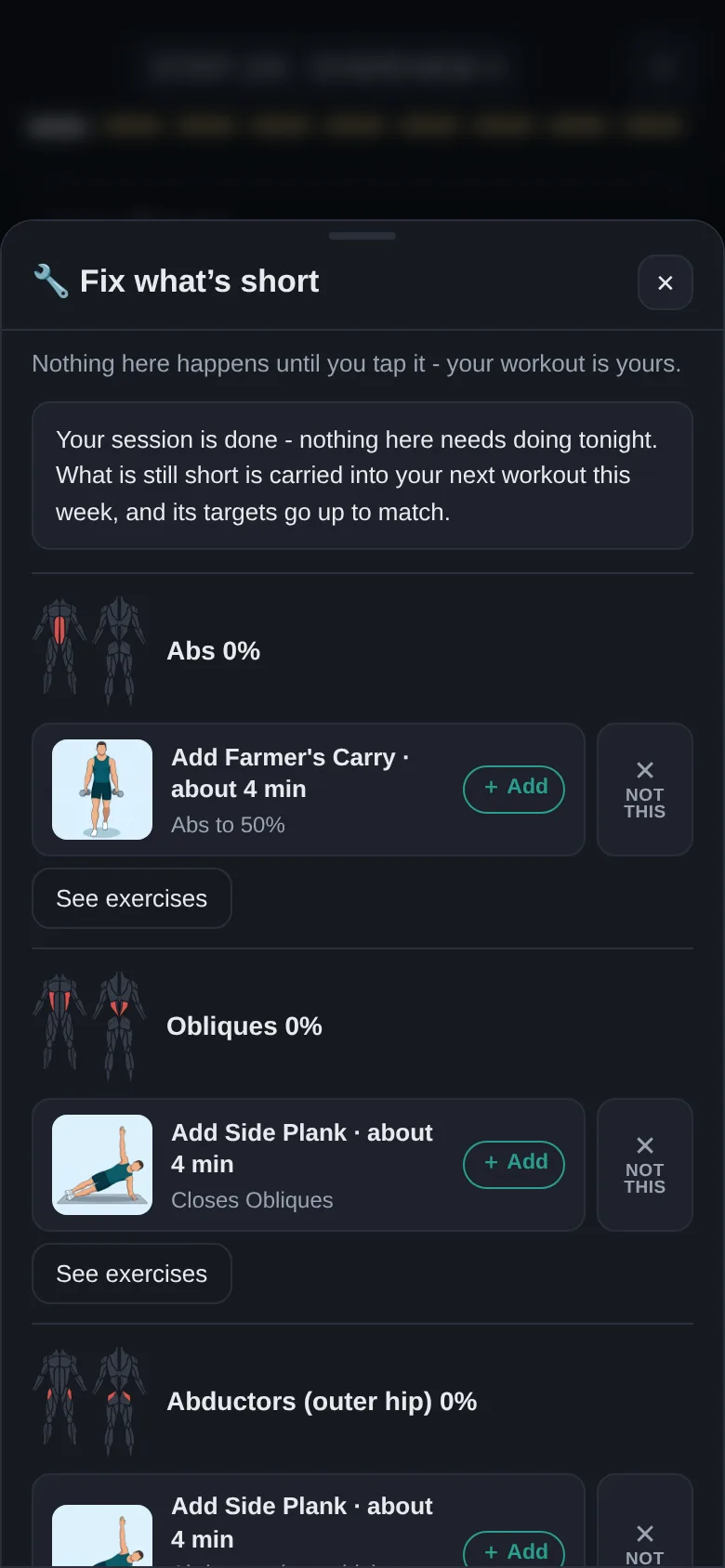
Before the comparison, the distinction that actually predicts frustration:
Free trial. Full app, then a wall. Fitbod gives you 7 days; Boostcamp the same. Nothing wrong with it, but it is not a free tier.
Free tier with a capped core feature. You can keep using it, but the thing you opened the app for is limited - a routine count, a history window, a chart range.
Free tier, ads instead. You pay in attention. Common in the large exercise-database apps.
Free tier with the core feature intact. Rare, and the only one that survives contact with a year of training.
The comparison
| App | What the free tier gives you | Paid |
|---|---|---|
| Hevy | Logging, routines, history and PRs, with a cap on how many routines you can save. The strongest pure logger here. | $2.99/mo, $23.99/yr, $74.99 once |
| JEFIT | A very large exercise database, logging and basic routines - with ads, and analytics behind the paid tier. | $12.99/mo, $69.99/yr |
| Boostcamp | Genuinely free access to published strength programmes. It is a programme runner, not a tracker you design. | $14.99/mo, $59.99/yr |
| Alpha Progression | 14-day trial, then the progression logic - the reason to use it - is paid. | $12.99/mo, $79.99/yr |
| Fitbod | 7-day trial. No free tier. | $15.99/mo, $95.99/yr |
| Full Coverage | Logging, your composed programme, every per-muscle percentage, the whole catalog, sessions you build and reorder yourself, and every chart at every range. No ads, no card. | $4.99/mo, $29/yr, $79 once |
Each figure checked against that vendor's own published pricing, on its own date: Fitbod 2026-08-04, Alpha Progression 2026-08-06, Hevy 2026-09-08, Boostcamp 2026-08-06, JEFIT 2026-08-06. One shared date would launder whichever number was oldest. Free-tier descriptions reflect what each vendor documents; tiers change, and this page is dated for that reason.
What to actually check before committing
Is your history exportable? A training log you cannot get out is a log you are renting. This is the single question most people skip and most regret.
Does the free tier keep the thing you came for? A logger whose free tier caps routines is a different proposition from one whose free tier caps history. Work out which limit you will hit.
Does it explain itself? Any app that generates workouts is making choices for you. If it will not tell you why it picked what it picked, you cannot tell a good session from a plausible one - and you certainly cannot tell when it is wrong.
Are you paying in attention? An ad-supported free tier is not free; it is a different currency, mid-set.
Where we fit, and where we do not
We built this one, so weigh the section accordingly. Full Coverage is free in the fourth sense above: everything you can see and touch stays free, including the numbers - every movement's per-muscle activation, the coverage map, the whole catalog, and a session you compose and reorder yourself that opens the same way next time. What is paid is the automation: the solver that composes the shortest session hitting every target, the ranked repair when a change leaves a muscle short, and superset pairing. Every new account gets 14 days of that, no card.
What it is not: a general training platform. No splits, no cardio programming, no nutrition, no social feed, and the catalog is 39 exercises rather than 1,400 - because every activation figure is hand-calibrated and we would rather publish fewer numbers we can defend. If you want a pure logger with a huge database, Hevy is a better answer. If you want published strength programmes, Boostcamp is.
Switch here if: you want to know which muscles your week actually covered, in numbers you can check, without a subscription to see them.
You can test that claim without installing anything: the coverage checker takes the movements you already train and shows what your routine misses, entirely in your browser.
Related guides
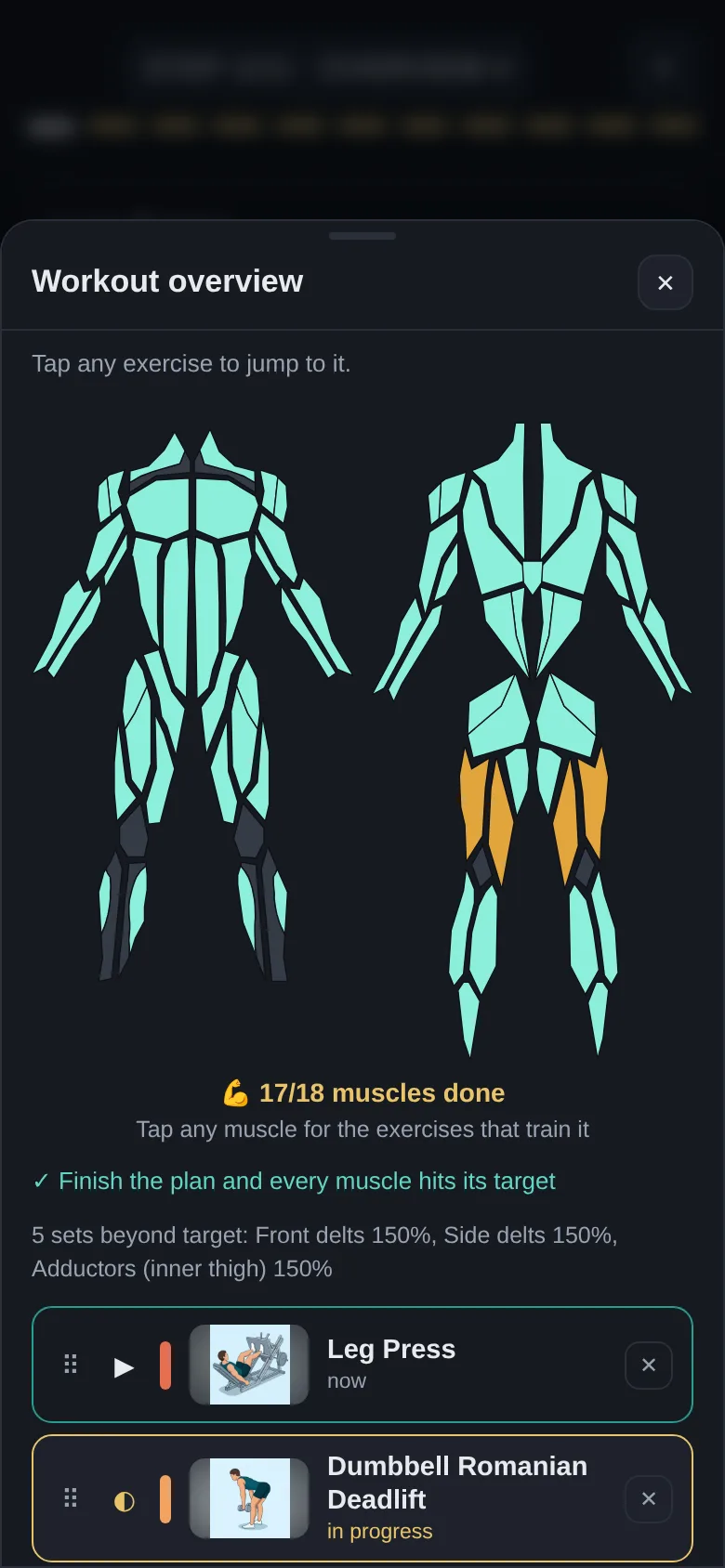
Hevy Alternatives: What a Workout Log Cannot Tell You
Hevy, Strong and JEFIT record what you lifted. Measured against 18 muscle groups, a log’s own chart calls ten of them empty when only two really are.
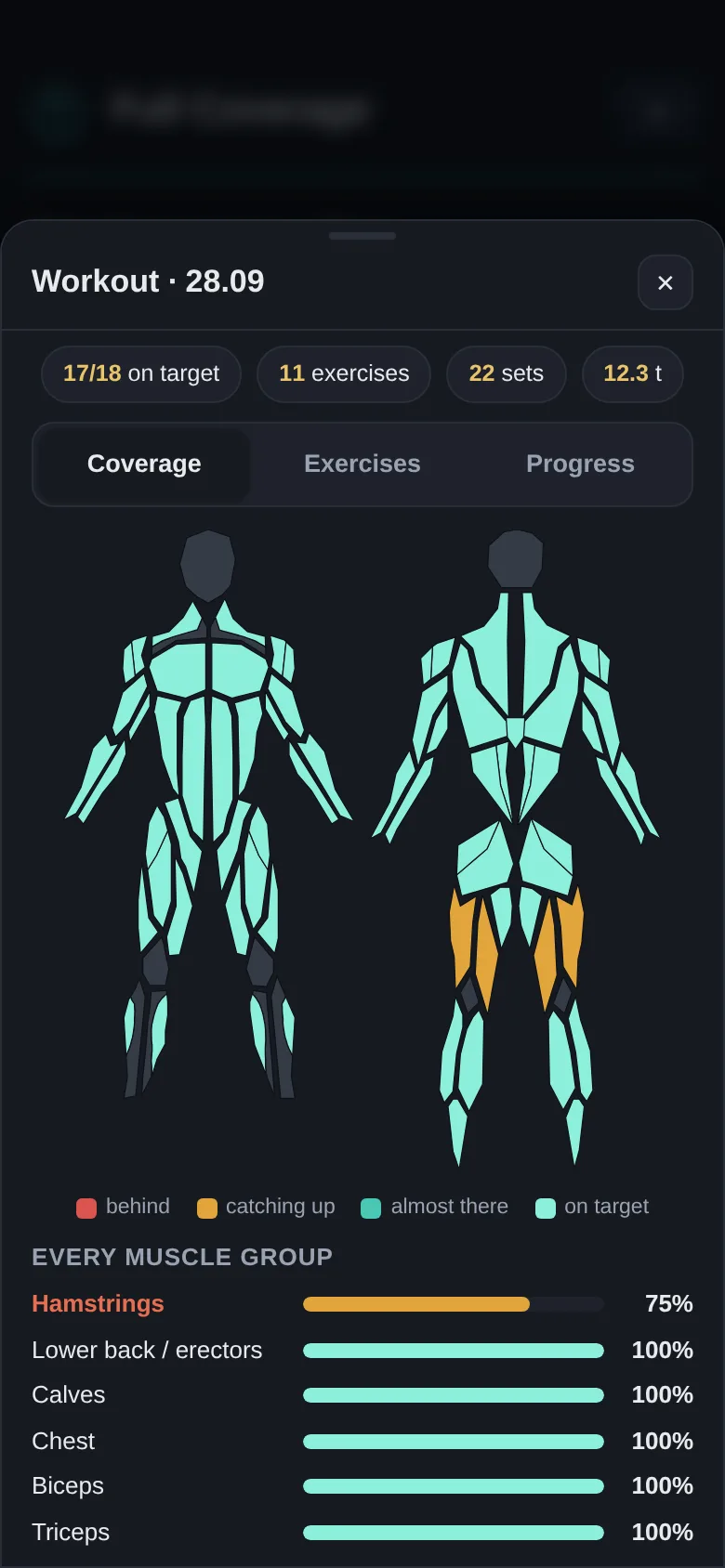
Muscle Heatmap Apps, and the Session They Cannot See
Muscle maps colour what you already trained. Read a complete session as a heatmap and 7 of 18 groups come out blank - every one of them on target.
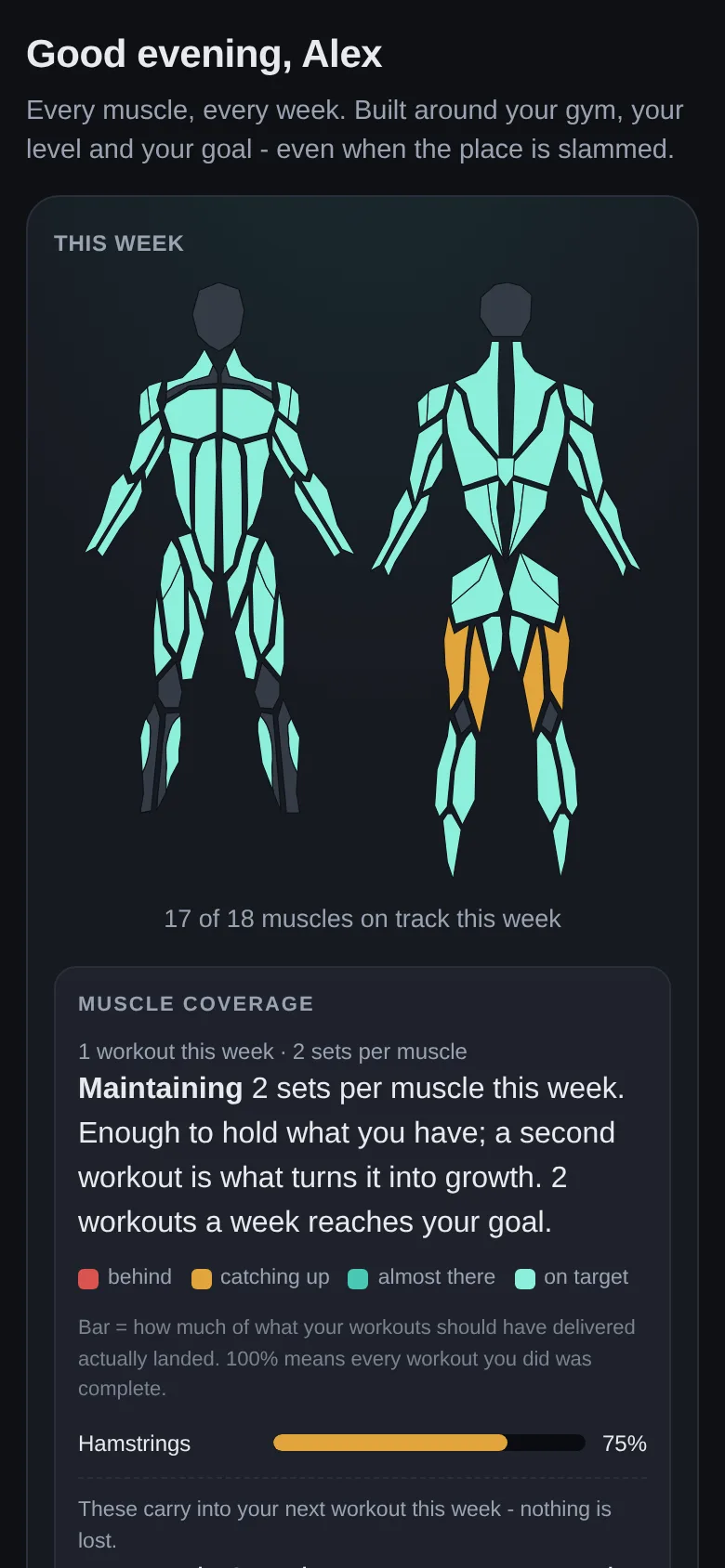
Fitbod Alternatives: 5 Apps Compared
An honest comparison of Fitbod alternatives - Alpha Progression, Hevy, Boostcamp, JEFIT and Full Coverage - with prices and who each one is for.