Guides / Fitbod Alternatives: 5 Apps Compared
Fitbod alternatives: 5 apps compared, and when to keep Fitbod
Almost everyone looking for a Fitbod alternative wants one of three things: the same kind of generated plan for less money, a plain logger with no plan at all, or a program a human wrote. This is which app is which, what each costs today, and the case where switching is a mistake.
By Mike Zino, founder · Updated 2026-08-06
Why people leave Fitbod
Fitbod is a good product, and most complaints about it are really complaints about fit. Three specific ones send people looking:
Price. $15.99 a month or $95.99 a year after a 7-day trial puts it at the top of this market. Every app below costs less, and three of them have a free tier you can stay on indefinitely.
Opacity. It builds your session from a model you can’t inspect. When it puts cable flys in today’s workout you get the instruction without the reasoning, which is fine if you want a plan handed to you and frustrating if you want to understand your own training.
You don’t need a generator. If you already know what you’re doing and just want to record it, you’re paying a generator’s price for a logger.
Those are three different problems with three different answers, so what follows is organised by problem rather than ranked one to five. "Best Fitbod alternative" has no single answer - it depends entirely on which of the three you have.
The five, side by side
| App | What it is | Free tier | Paid |
|---|---|---|---|
| Fitbod | AI session generator | Trial only (7 days) | $15.99/mo, $95.99/yr |
| Alpha Progression | AI generator with overload tracking | Trial only (14 days) | $12.99/mo, $79.99/yr |
| Hevy | Workout logger | Yes (routines, logging, social) | $2.99/mo, $23.99/yr, $74.99 lifetime |
| Boostcamp | Library of coach-written programs, plus a logger | Yes (11,000+ programs, full tracker) | $59.99/yr, or $14.99/mo |
| JEFIT | Exercise library, logger and community | Yes (1,400+ exercises, logging) | $12.99/mo, $69.99/yr |
| Full Coverage | Full-body program with a visible per-muscle coverage engine | Yes (the whole program and every percentage) | $4.99/mo, $29/yr, $79 lifetime |
Prices are USD list prices read from each vendor’s own pricing page or App Store listing, not from other roundups. Dates are in the last section.
If you want the same thing for less: Alpha Progression
The closest like-for-like swap. It generates sessions and manages progressive overload the way Fitbod does, at $12.99/mo or $79.99/yr with a 14-day trial - so you keep the "tell me what to do today" experience and stop paying the premium for it.
The catch is that it’s the same shape of product, so it inherits the same trade: you are still trusting a generator. If your reason for leaving was price, this is the answer. If it was opacity, you have moved sideways.
Switch here if: you like Fitbod and object to the bill.
If you don’t need a generator at all: Hevy
Hevy is a logger, and it is very good at being a logger: fast set-and-rep entry, routines, charts, a social feed. The free tier is genuinely usable rather than a trial in disguise, and Pro is $2.99/mo, $23.99/yr, or $74.99 once - the cheapest paid tier on this page by a wide margin.
It will not tell you what to train. That is the entire point of it, and it is the right pick for the large group of people who already have a program and were only using Fitbod as an expensive notebook.
Switch here if: you know what you’re doing and want to record it, cheaply, forever.
If you’d rather follow a program a coach wrote: Boostcamp
A different answer to the same question. Instead of generating something fresh each session, Boostcamp gives you the established programs - 5/3/1, GZCLP, nSuns and thousands more - and tracks you through them. The free tier covers the program library and the full logger with no time limit; Pro ($59.99/yr, or $14.99/mo) adds analytics and exclusive coach programs.
An algorithm improvising a session is not obviously better than a proven block written by a coach and run for years. If you were using Fitbod because you wanted structure, structure is what this is.
Switch here if: you want a real program with a beginning and an end, not a fresh suggestion every day.
If you want the largest exercise library: JEFIT
JEFIT is the veteran of the category: 1,400+ exercises with instructions, routine building, logging and an active community, free, with Elite at $12.99/mo or $69.99/yr for the ad-free experience and deeper analytics.
The library is the draw. If your gym has unusual machines, or you want to browse a lot of options for one movement, this has the widest selection here.
Switch here if: breadth of exercise choice matters more to you than what an app tells you to do with it.
If the problem is not knowing what you’re missing: Full Coverage
We built this, so treat the section accordingly - but it answers a question none of the four above do, and it is a narrow question.
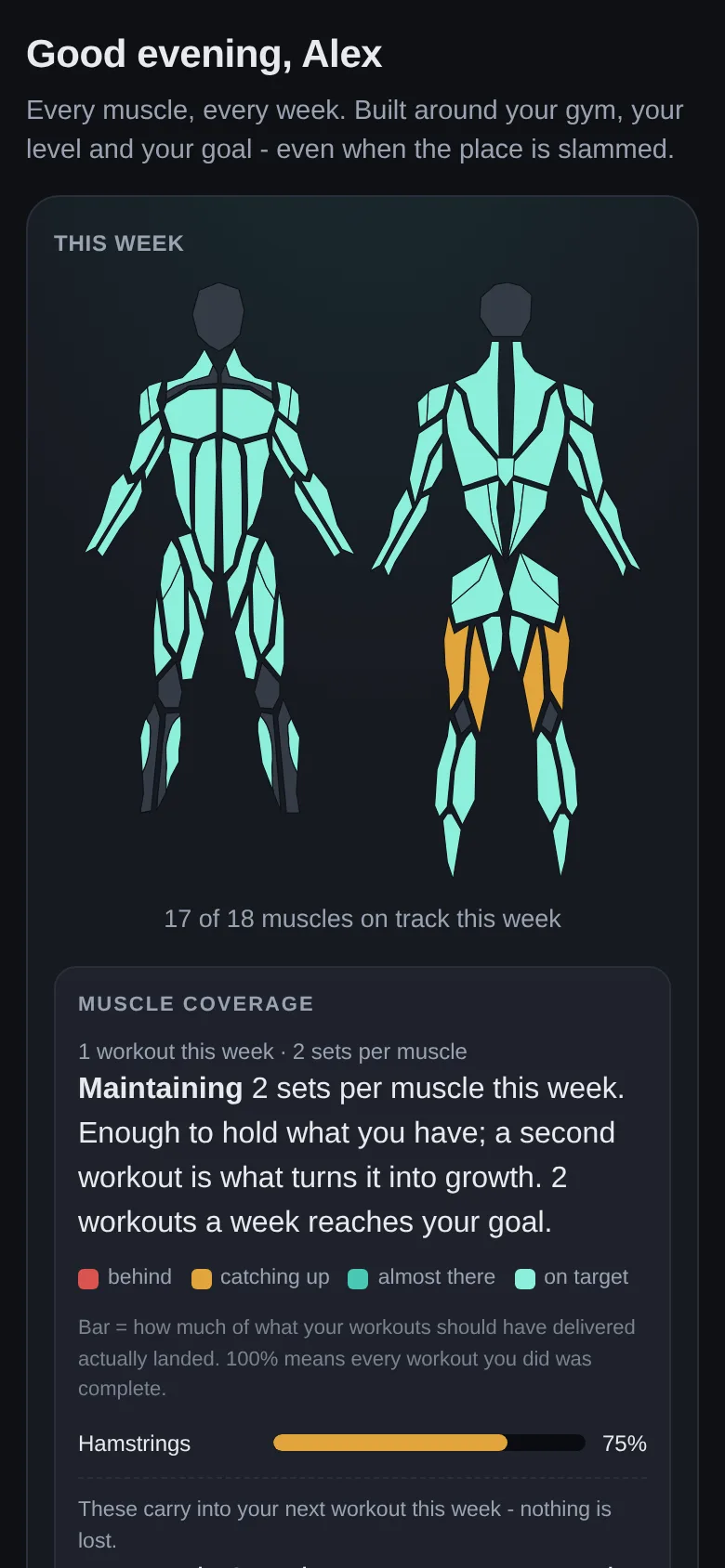
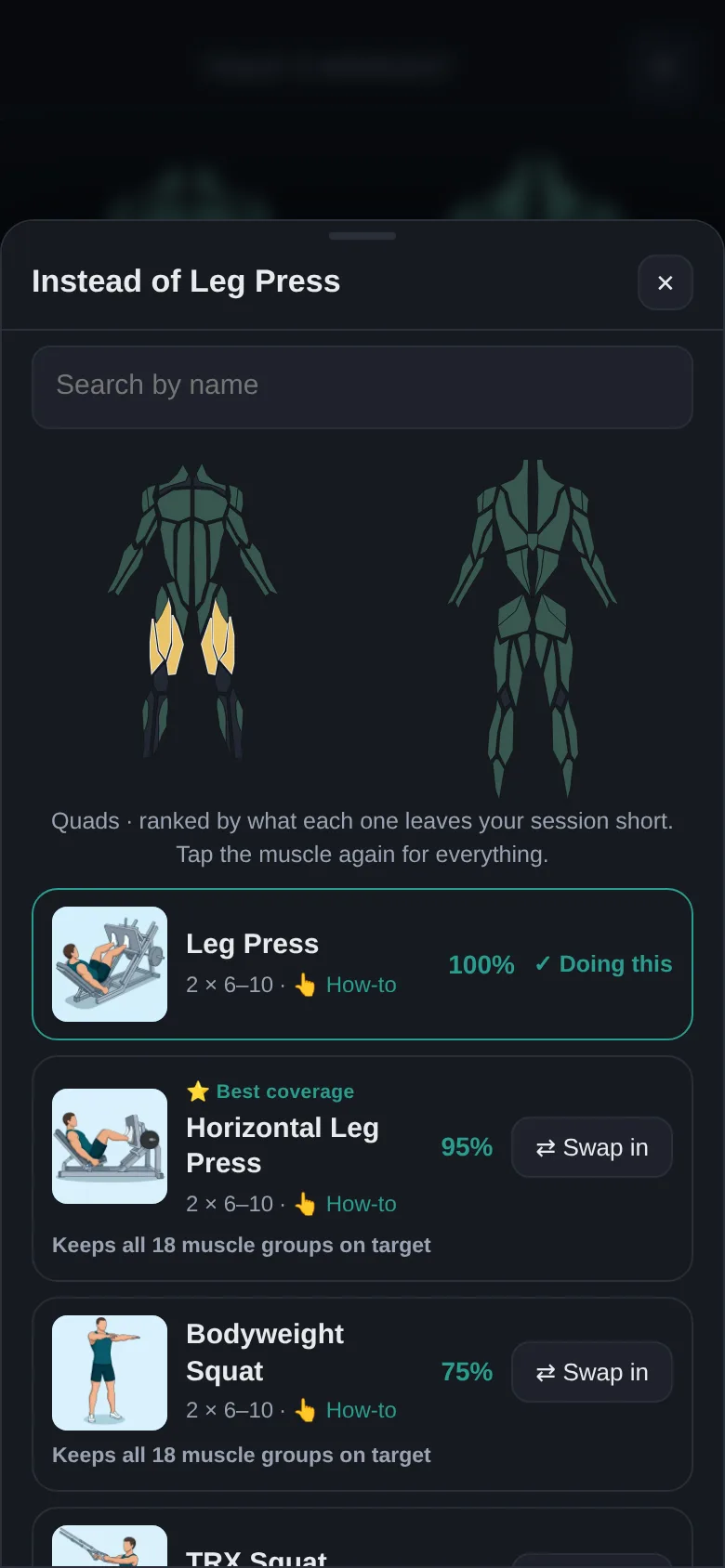
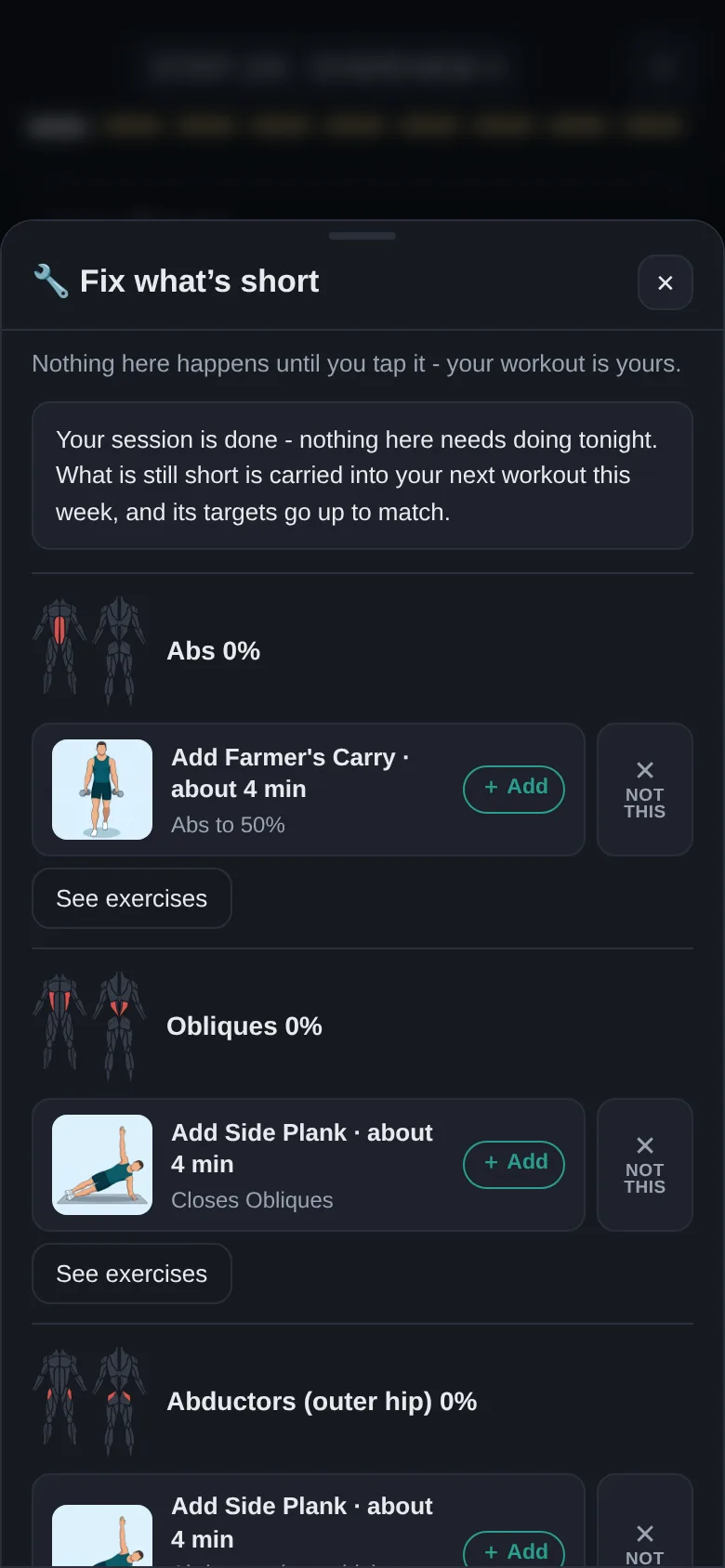
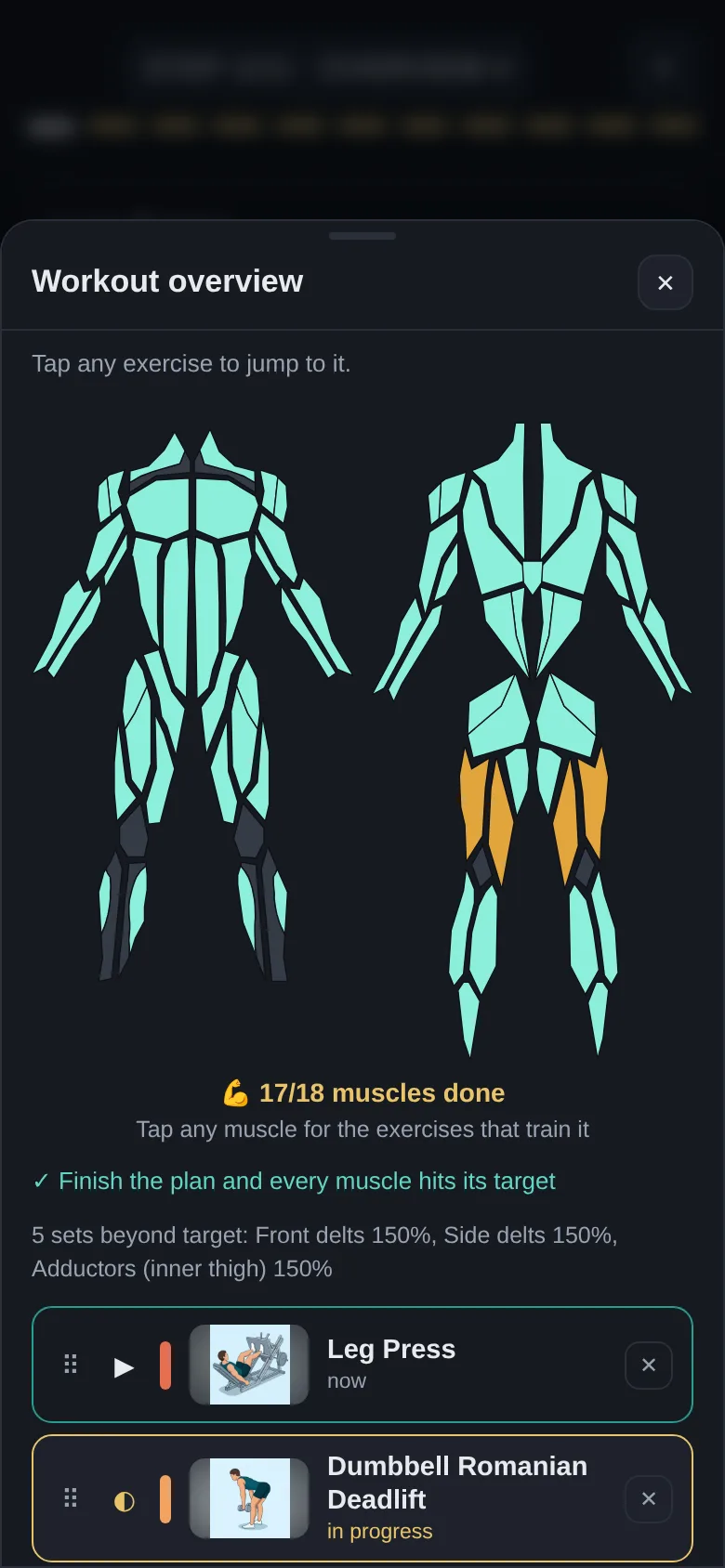
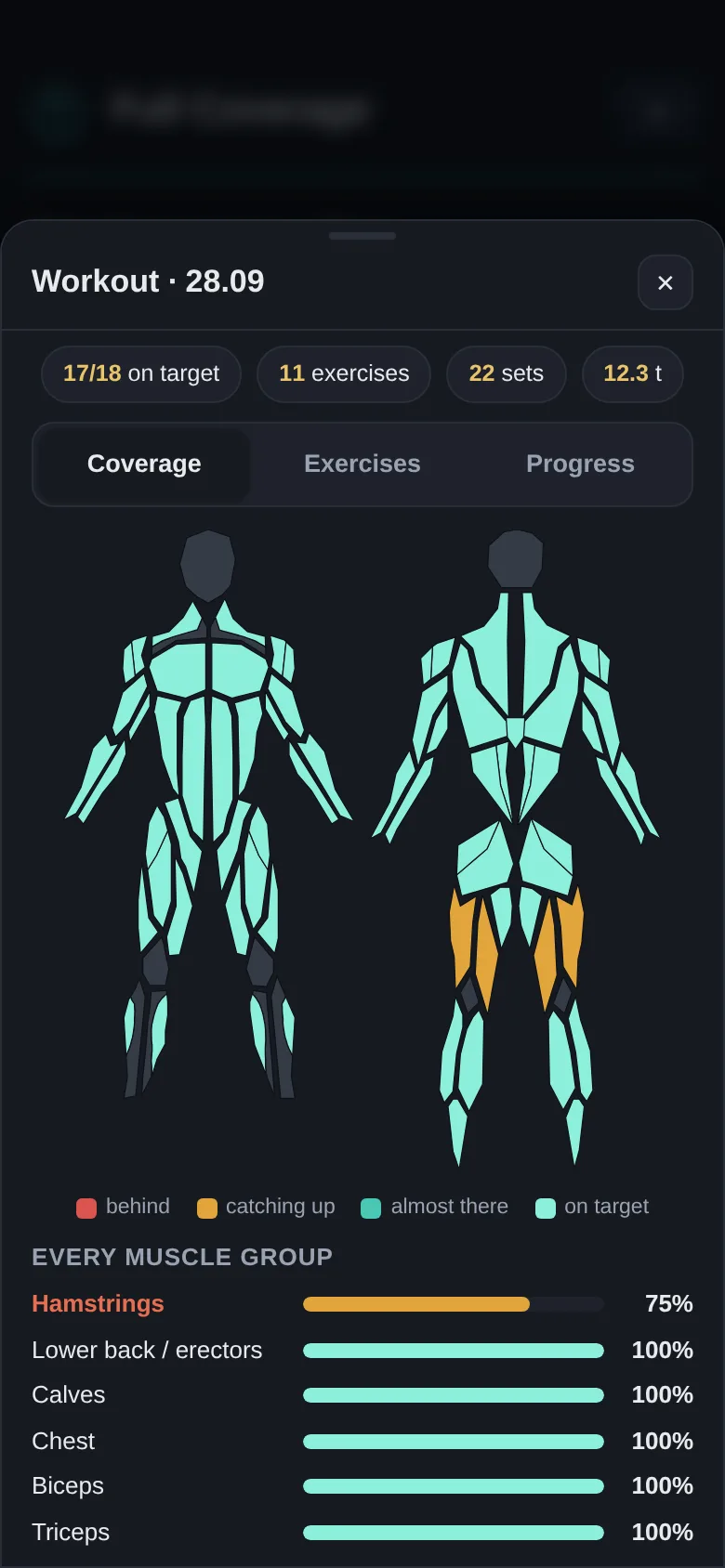
Every exercise carries a per-muscle activation vector: the share of one session’s target it contributes to each of 18 muscle groups. Those numbers drive the program, the swaps and the map, and they are on screen while they do it. So the app can tell you your week reached every group but one, and name it - and you can check the arithmetic rather than trust it. The free tier includes the entire composed program, every percentage, set-by-set logging, PRs, streaks, the coverage map, manual swaps, the whole catalog to browse, and a session you build and reorder yourself that opens the same way next time - with no card. Pro ($4.99/mo, $29/yr, or $79 once) adds the autopilot that composes the shortest session reaching 100% on everything, and the ranked repair when a change leaves a muscle short; every new account starts with 14 days of it.
What it is not: a general training platform. There are no splits, no cardio programming, no nutrition, no social feed, and the catalog is 39 exercises deep rather than 1,400 - because every vector is hand-calibrated and we would rather publish fewer numbers we can defend. It trains full body, every session, on the argument that a full-body session is forgiving: miss a day and the next one still covers everything. If you want push/pull/legs, we are the wrong app and one of the four above is right.
You can test the idea without installing anything. The free coverage checker takes the movements you already train and shows you which muscle groups your routine leaves short. Nothing is sent anywhere and there is no signup.
Switch here if: you suspect your routine has a hole in it and you want the app to prove where, rather than assert what.
When switching is a mistake
Keep Fitbod if the generator is doing something for you that you would otherwise not do. Its real value is decision removal: open the app, do what it says, go home. That is worth $15.99 a month to plenty of people, and every alternative here asks you to make a choice Fitbod was making for you - which program, which exercises, which split.
Keep it too if you want one app for everything. Fitbod covers gym, home, bodyweight, cardio and equipment-limited training across a large library with a mature iOS and Android experience. Most apps on this page, ours very much included, do one thing.
And be honest about the actual failure mode: people rarely stop training because their app was wrong. They stop because they stopped opening it. If you open Fitbod, that is worth more than any feature on this page.
Where these numbers come from
Every price above is a claim about somebody else’s product, so each is read from a first-party source and dated rather than copied from another roundup:
Fitbod - published subscription pricing, checked 2026-08-04.
Alpha Progression - alphaprogression.com/en/subscribe, checked 2026-08-06.
Hevy - App Store in-app purchase list + listing description, checked 2026-09-08.
Boostcamp - boostcamp.app/pro, checked 2026-08-06.
JEFIT - jefit.com/elite, checked 2026-08-06.
Prices change and vary by region, store and promotion; check before you buy. If you find one of these out of date, tell us and we will re-check it.
Related guides
Free Workout Trackers: No Subscription
Which workout trackers are genuinely usable without paying - compared on what each free tier actually does, not on what its paid tier costs.
Hevy Alternatives: What a Workout Log Cannot Tell You
Hevy, Strong and JEFIT record what you lifted. Measured against 18 muscle groups, a log’s own chart calls ten of them empty when only two really are.
Muscle Heatmap Apps, and the Session They Cannot See
Muscle maps colour what you already trained. Read a complete session as a heatmap and 7 of 18 groups come out blank - every one of them on target.
Full-Body Workout for a Crowded Gym
Peak-hour gym, every good station taken? Here’s how to still hit every muscle group in one session - without waiting or skipping anything.