Guides / What Order Should You Do Exercises In?
What order should you do exercises in?
Almost every article on this answers "compounds first, isolation after" and publishes no arithmetic behind it. The honest answer is stranger and more useful: for muscle growth, the pooled evidence says order does not matter at all. For strength it matters quite a lot, and not in the direction most people assume. Here is what the research found, and the two rules that survive it.
By Mike Zino, founder · Updated 2026-09-30
The short answer
A meta-analysis pooled 11 training studies covering 268 participants and compared sessions that started with multi-joint lifts against sessions that started with single-joint work Nunes 2021. For hypertrophy it found nothing: an effect size of 0.03, p = 0.862. That is not "a small benefit" - it is no detectable difference at all.
For strength it found something real. You improve most at whatever you do first, whichever that is. And the size of that advantage is not equal: single-joint exercises gained roughly twice as much from being first (0.58) as multi-joint exercises did (0.32).
Read those two results together and the usual advice comes out inverted. "Compounds first" is not a rule about growing more muscle - the evidence says that is a wash. It is a rule about which lift you want to get stronger at, and it is a preference, not a law. If your goal is a bigger bench, bench first. If your goal is side delts that finally catch up, the lateral raise has a better claim on being first than the overhead press does.
So why order a session at all?
Two reasons, and neither is a growth claim.
Fresh work goes where it counts. Something has to be first. If the position carries a measurable strength advantage, it should go to whatever you most want to improve, not to whatever happened to sort first in a list. That is a decision, and an app that does not make it has simply left it to chance.
Nothing should be pre-fatigued by the station before it. This one is not a training theory, it is arithmetic about load. If two movements in a row are both driven by your quadriceps, the second is performed on a muscle that just did the first, and the weight on it drops. Doing the same two with something else in between is free - it costs no extra time and no extra sets.
Notice what is missing from both: any promise that you will grow more. The literature does not support one and we are not going to imply one.
What the app actually does
Every movement in the catalog carries a pattern - squat, hinge, horizontal press, vertical pull, side delt, calf, core and the rest, 33 of them in all. Each pattern has a rank, and the ranks fall into four bands:
- Whole-body and lower-body compounds - get-up, squat, thruster, lunge, split squat, step-up, hinge, glutes.
- Upper-body compounds - horizontal press, vertical pull, horizontal row, vertical press, pullover.
- Isolation - side and rear delts, chest, biceps, triceps, adduction, abduction, quads, hamstrings, lower back, calves, forearms, traps, carries.
- Core, last. Your trunk braces everything above it, so fatiguing it first makes every later lift worse at no benefit.
Then a second pass: where two neighbouring stations share a prime mover - a muscle taking at least half of one session’s dose in both movements - it swaps in the next station that does not, provided that station is in the same band. Same band only, deliberately. The bands are the training-order decision; this is a tie-break inside one, and it must never lift an isolation movement above a compound to avoid a clash.
What that looks like on a real session
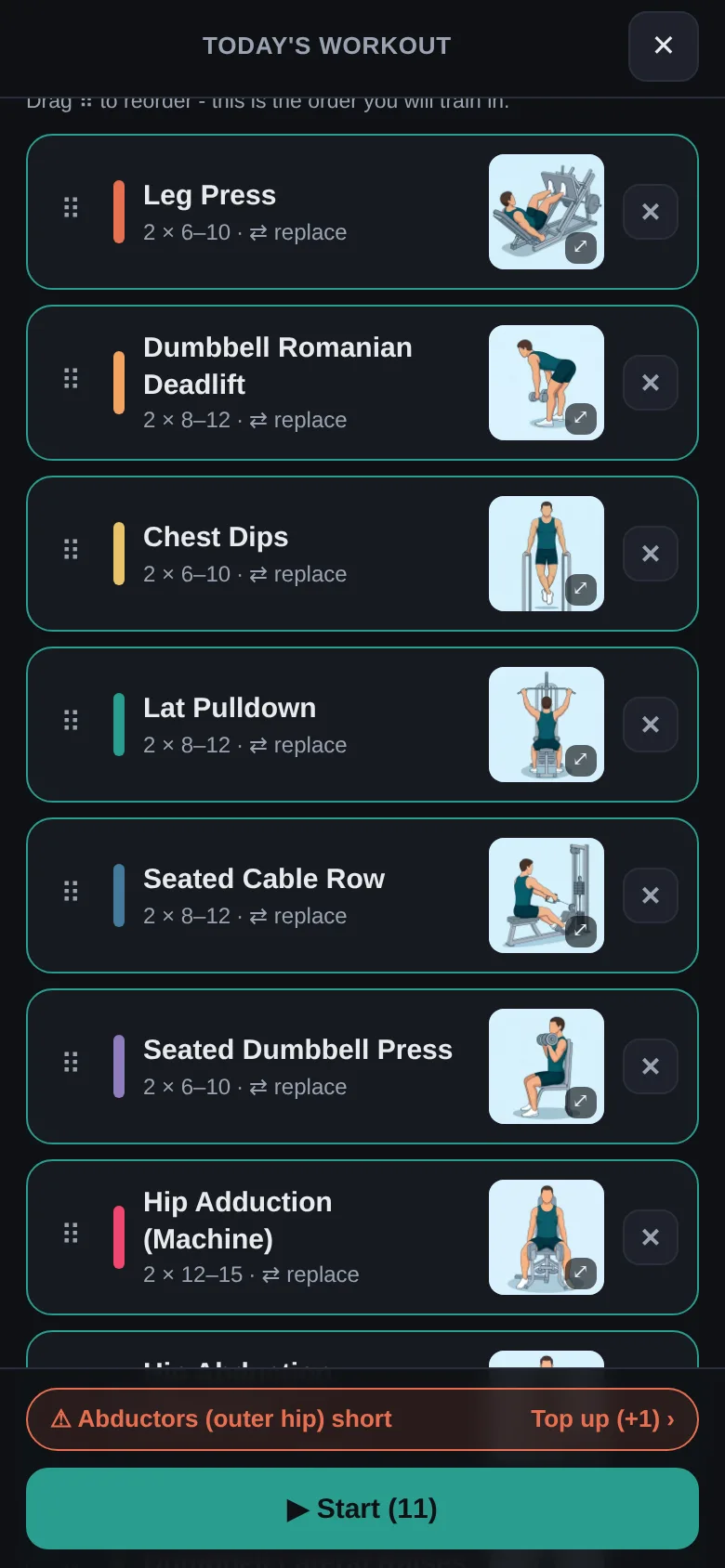
Here is the default full-body session the composer produces, in the order it hands you:
Barbell Squat → Romanian Deadlift → Barbell Bench Press → Lat Pulldown → Seated Cable Row → Overhead Barbell Press → Hip Adduction → Dumbbell Lateral Raises → Hip Abduction → Standing Calf Raises → core
The interesting placement is the hip adduction machine sitting between the overhead press and the lateral raise. By rank alone the lateral raise comes first - it is a shoulder movement and adduction is a hip movement much further down the list. But the overhead press and the lateral raise share the side delt as a prime mover, so the app puts a leg movement between them. Both shoulder movements are then performed fresh, and it cost nothing.
And here is the limit, stated rather than hidden: the squat and the Romanian deadlift are still back to back, and they share the glutes. They are both band-one compounds, and the only station that could separate them is a bench press from band two - which would mean pulling an upper-body compound above a lower-body one to fix a fatigue clash. That is the wrong trade, so the app does not make it. One unavoidable overlap in eleven stations, at the top of the session where you are freshest, is the right place for it to land.
And you can just drag them
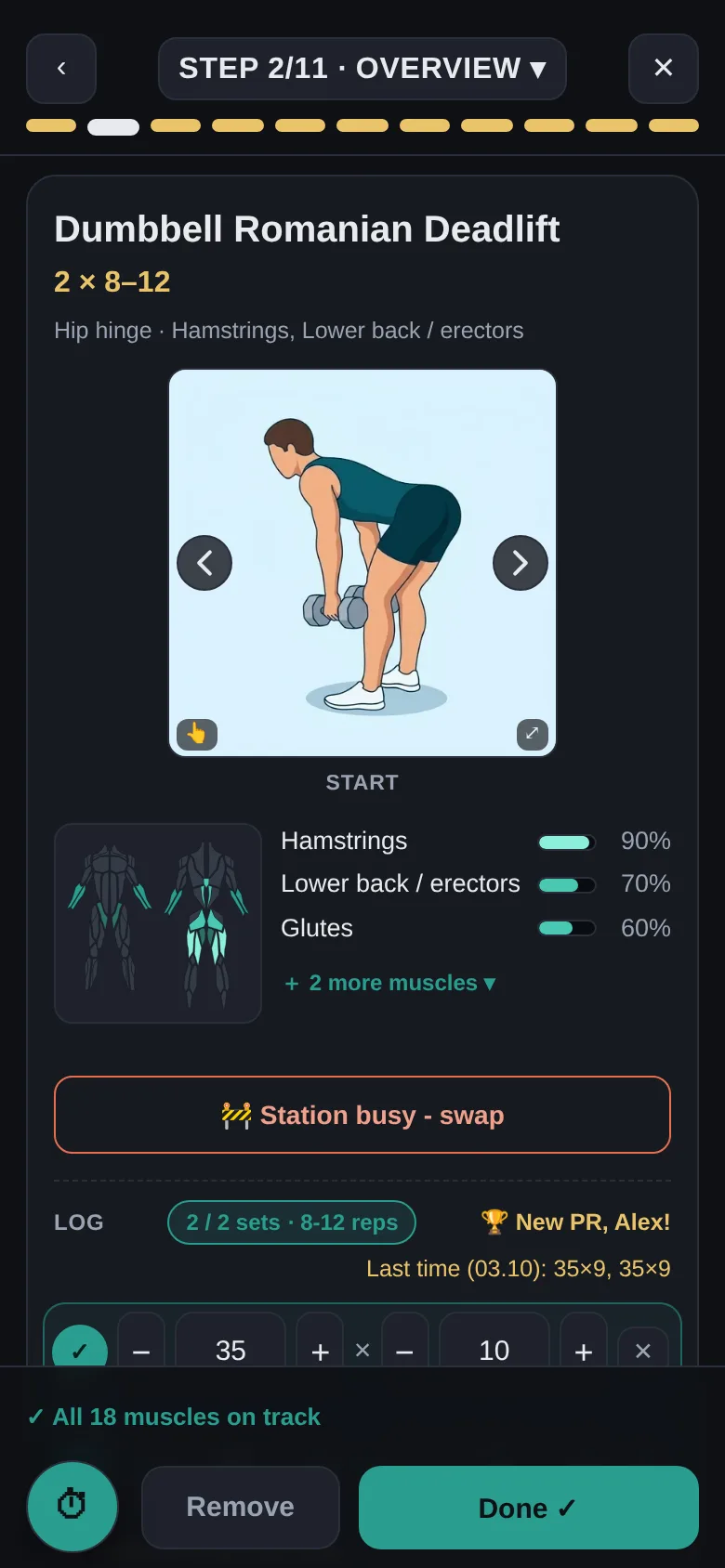
None of this is locked. Every station in the session list has a drag handle, and the order you leave it in is the order you train in - it is saved with your workout and nothing recomposes it behind your back. The ordering rules are a starting point that is defensible rather than arbitrary, which is a different thing from being correct for you.
The one place an order really is worth overriding is the one the research points at. If there is a lift you are actively trying to add weight to, put it first - that is the only part of this whole question with a clear effect behind it.
The short version: exercise order has no measurable effect on muscle growth - 11 studies, 268 people, effect size 0.03 Nunes 2021. It does affect strength in whatever you do first, and single-joint work benefits from that position about twice as much as compound work does. So: put the lift you most want to improve first, keep core last, and avoid training the same muscle twice in a row. Everything beyond that is preference, and anyone selling you a strict sequence for hypertrophy is selling you something the evidence does not have.
Related guides
How Many Exercises Per Workout?
The usual answer is 4-7 exercises. Measured against every muscle group, that leaves a third of them short - and the exercises people add next fix none of it.
How Many Sets Per Muscle Per Week?
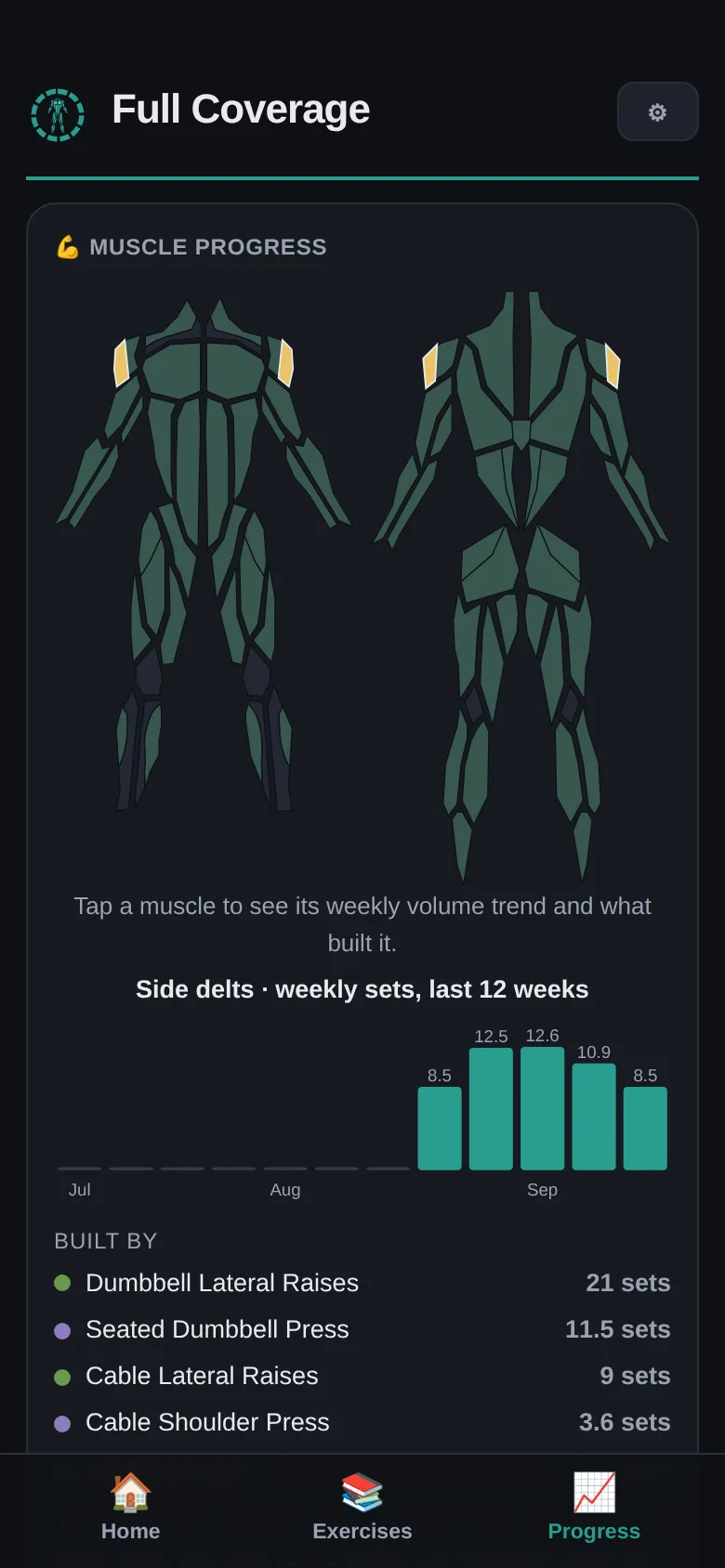
The weekly set ranges the research supports, what counts as a set when an exercise only assists a muscle, and the ceiling on what one session delivers.
Full Body vs. Push/Pull/Legs for a Busy Week
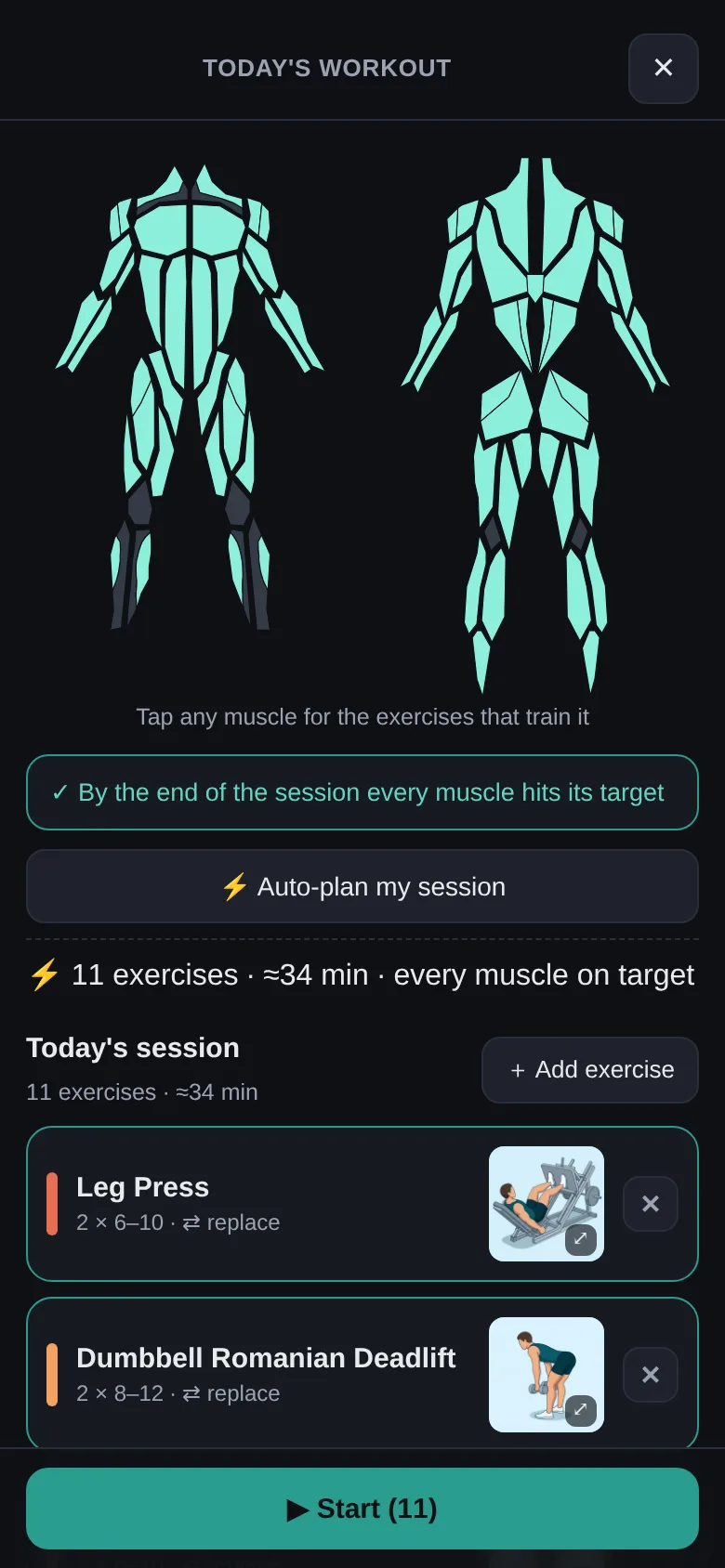
Full body 2–3x a week vs. a 3-day push/pull/legs split - how they compare on missed workouts, time per session, and total weekly muscle coverage.
Full-Body Workout for a Crowded Gym
Peak-hour gym, every good station taken? Here’s how to still hit every muscle group in one session - without waiting or skipping anything.