Guides / How Often Should You Train Each Muscle?
How often should you train each muscle?
Train every muscle three times a week, the internet says, and you will grow faster than training it once. The research does not support that, and the reason why is more useful than the rule it replaces.
By Mike Zino, founder · Updated 2026-08-07
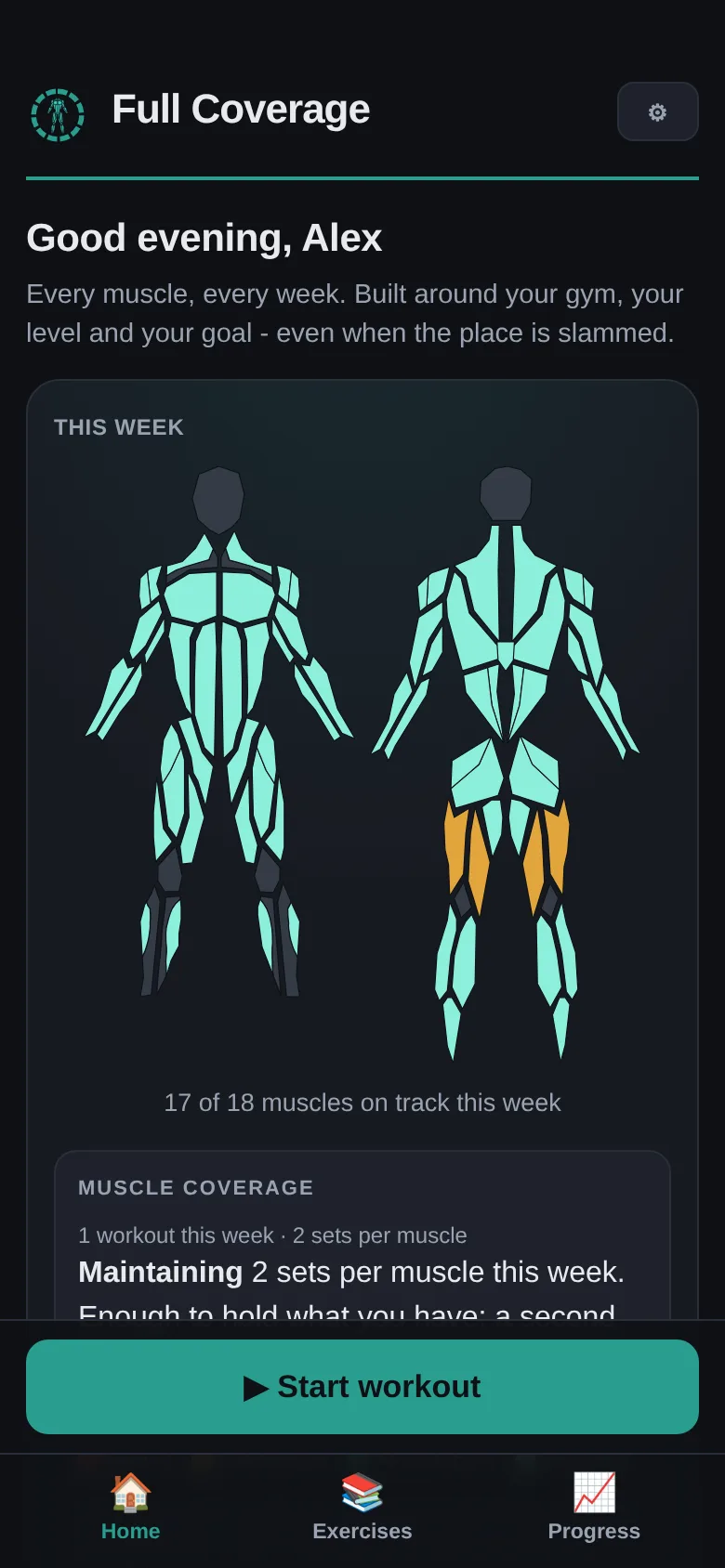
The finding most training advice skips
When researchers compare training a muscle once, twice or three times a week while keeping the total number of weekly sets the same, the differences in muscle growth are not meaningful. A meta-analysis dedicated to the question found no significant effect of frequency once volume was equated Schoenfeld 2019, and the largest dose-response analysis available describes frequency’s independent effect on hypertrophy as “compatible with negligible effects” Pelland 2025.
Read that carefully, because it is easy to over-correct. It does not say frequency is useless. It says frequency is not the mechanism. Volume is the mechanism, and frequency is how you deliver it.
So why does training more often work?
Because in real life nobody equates volume. If you train a muscle once a week you will do maybe three or four hard sets for it. Train it three times and you will do nine or twelve, without any single session becoming punishing. The extra growth comes from the extra sets - the frequency is just what made them fit.
Past roughly 11 fractional sets for one muscle in one session, additional work stops showing a detectable benefit Remmert 2025. Above a certain weekly target, more days is the only route.
The exception: training for strength
Strength behaves differently, and it is the one place the “train it more often” advice holds on its own terms. The same analysis that found frequency negligible for muscle size found the opposite for strength: the probability of a positive effect was 100%, with gains increasing as frequency increased Pelland 2025.
That is consistent with what strength actually is - a skill as much as a tissue property. More exposures to a heavy barbell make you better at lifting a heavy barbell, in a way that more exposures do not straightforwardly make a muscle bigger.
What to actually do
Two sessions a week is the floor, and it is not our opinion: the WHO and the ACSM both set the bar at all major muscle groups on two or more days a week, at 2-3 sets per exercise Currier 2026.
Three is where the volume lands well for most people chasing size. At a full-body session giving each muscle 2-3 sets, three sessions puts you at 4-9 sets per muscle per week - the range where the strongest results were found Schoenfeld 2017.
More than that is a preference, not a requirement. If four or five sessions fit your life and you recover from them, they will add volume and volume helps. If they do not fit, you are not leaving much on the table - which is the genuinely freeing implication of the research at the top of this page.
The mistake worth avoiding is the opposite one: training a muscle once a week and expecting a three-times-a-week result. That is not a frequency problem, it is a volume problem wearing a frequency costume.
How Full Coverage handles it
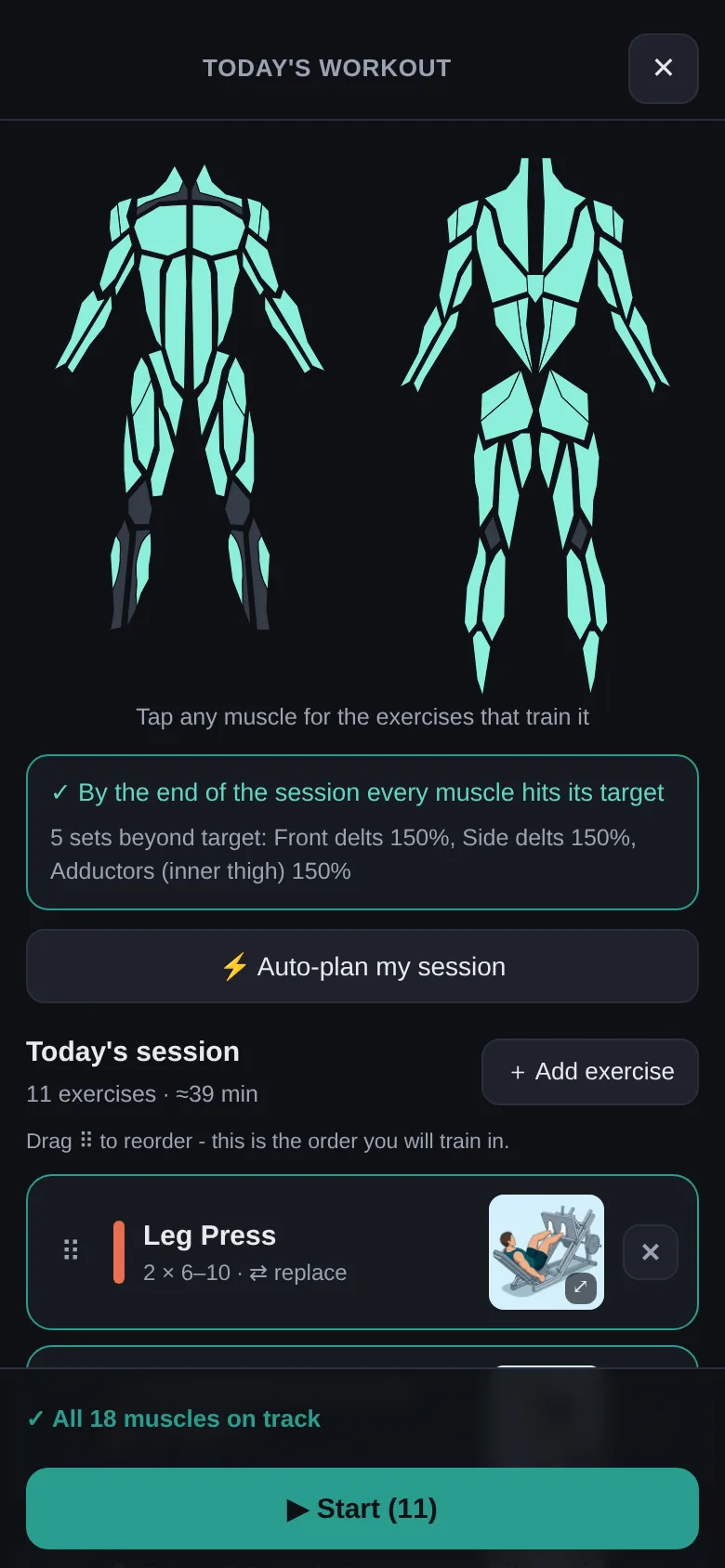
One workout takes every muscle group to 100% - a fixed amount of work that does not shrink because you train more often. Training more often multiplies your weekly volume rather than dividing your sessions into smaller pieces, and the app reports the weekly total with the band it falls into rather than setting it as a target you can fail.
That design follows directly from the research above. If frequency were the mechanism, the right model would be to chase sessions. Since volume is the mechanism, the right model is to make each session complete and let you choose how many you do. Every figure quoted here is on the evidence page with its source.
Related guides
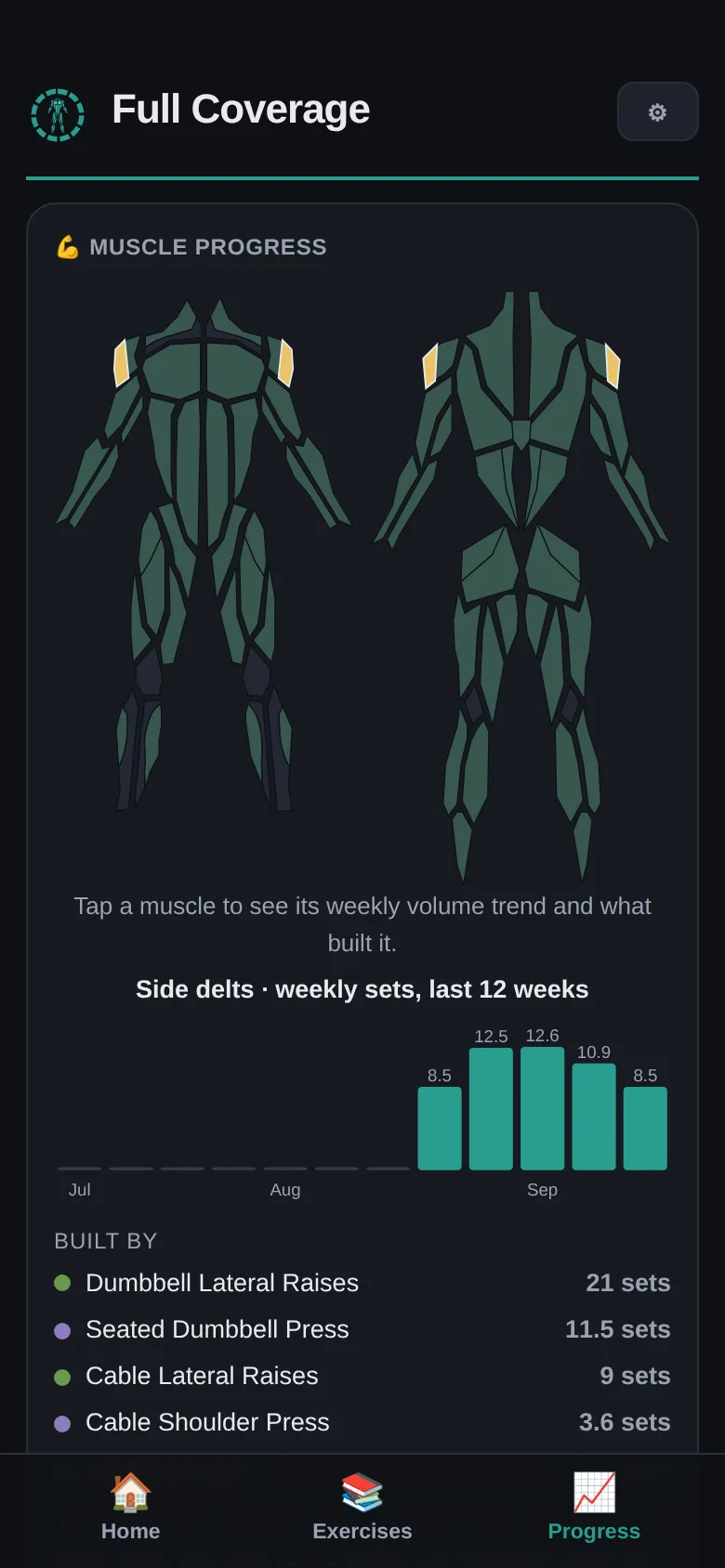
How Many Sets Per Muscle Per Week?
The weekly set ranges the research supports, what counts as a set when an exercise only assists a muscle, and the ceiling on what one session delivers.
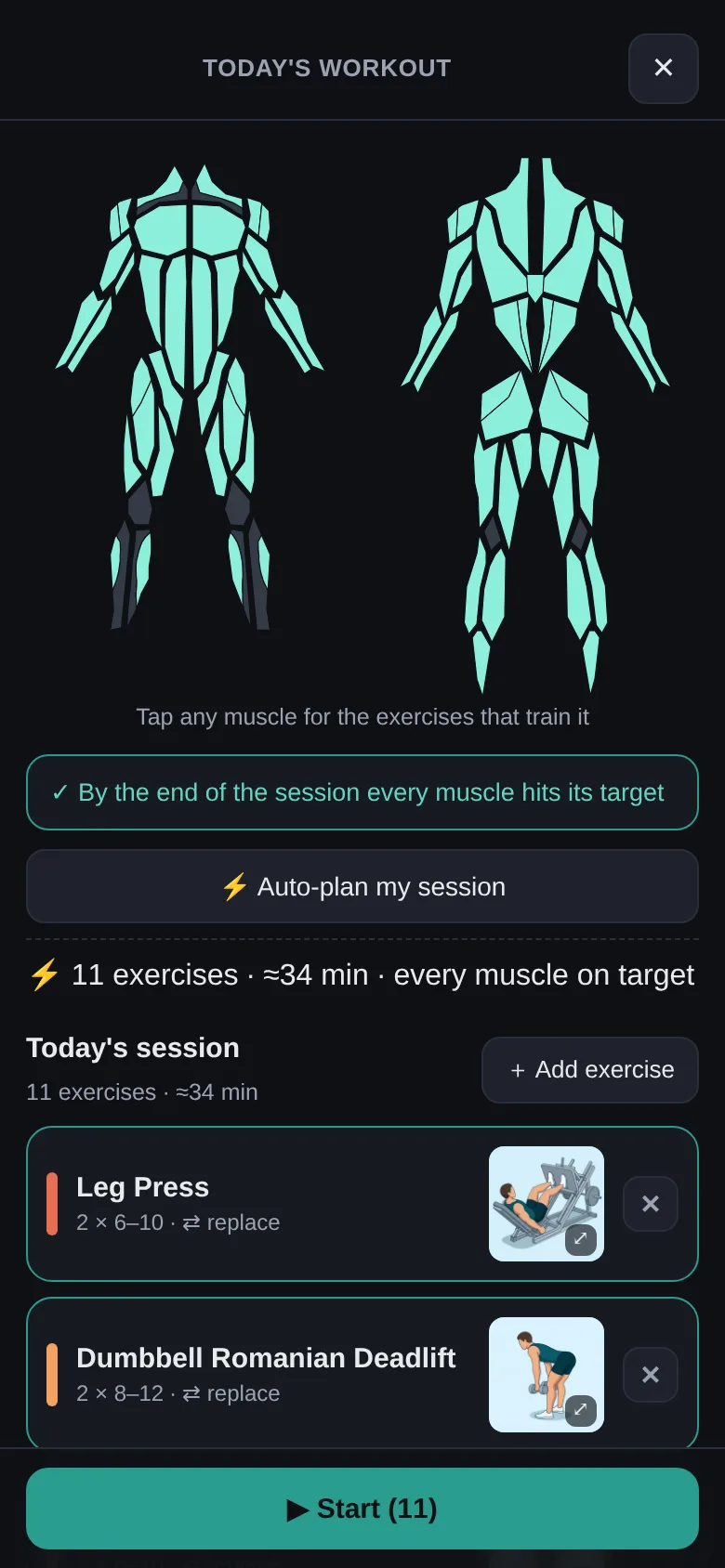
Full Body vs. Push/Pull/Legs for a Busy Week
Full body 2–3x a week vs. a 3-day push/pull/legs split - how they compare on missed workouts, time per session, and total weekly muscle coverage.
How Many Exercises Per Workout?
The usual answer is 4-7 exercises. Measured against every muscle group, that leaves a third of them short - and the exercises people add next fix none of it.